Calathea Orbifolia Care: How to Stop Crispy Brown Edges
The real science behind prayer plant leaf movement, tap water mineral sensitivity, and how to prevent brown crispy edges indoors.

Taming the “Diva” of the Tropical World
Among indoor plant collectors, Calathea orbifolia (botanically reclassified as Goeppertia orbifolia) has a reputation for being notoriously dramatic. With its oversized, dinner-plate leaves painted in alternating metallic silver and lime green stripes, it is easily one of the most stunning foliage plants you can grow in a living room. Yet plant groups are filled with photos of sad, crispy Orbifolias with brown curled edges.
I will admit, I killed my very first Orbifolia six years ago by making every classic mistake in the book: watering it straight from the kitchen faucet, putting it in front of a drafty air vent, and misting it with a spray bottle. But Calatheas are not actually mysterious or impossible. Once you understand the physical structure of their leaf joints and their unique sensitivity to tap water minerals, keeping those wide striped leaves soft and healthy is completely doable.
The Science: Night Dancing and Tap Water Burn
1. The Pulvinus: Why Your Plant Moves Every Night
If you sit in a quiet room at dusk, you might actually hear your Calathea rustle. Members of the prayer plant family (*Marantaceae*) raise their leaves vertically at night and lower them horizontally during the day (Borchsenius et al., 2012). This circadian rhythm is called nyctinasty.
This movement is powered by a small swollen joint at the base of each leaf called the pulvinus. Research by plant physiologists (Ueda et al., 2007) shows that the pulvinus acts like a biological hydraulic pump. By shifting potassium and chloride ions between its cells, water rushes in and out of the joint, changing cell pressure and raising or lowering the heavy leaf blade to track changing light and shed excess nighttime condensation.
2. Why Tap Water Burns Leaf Edges
The single biggest reason Calatheas develop crispy brown margins is mineral toxicity from municipal tap water. Seminal research by horticultural scientists Poole and Conover (1981) demonstrated that *Marantaceae* plants cannot process tap water chemicals like fluoride, chlorine, and soluble mineral salts.
When you water with hard tap water, the plant absorbs these dissolved minerals through its roots and pushes them all the way out to the leaf edges during transpiration. Because the minerals cannot evaporate into the air, they accumulate in the delicate perimeter cells until the tissue dries out and dies, forming a brittle brown crust around the leaf.
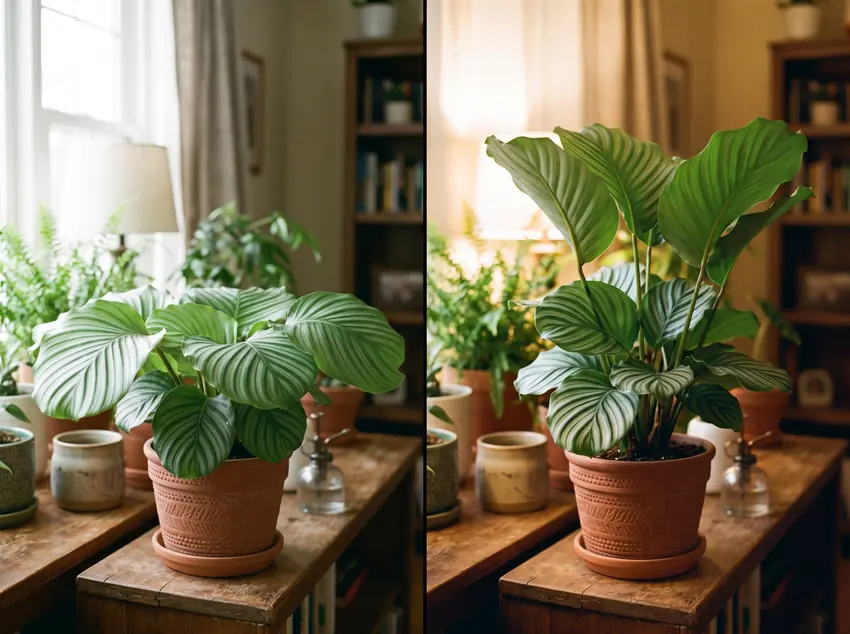
Everyday Calathea Orbifolia Care: How to Keep Leaves Healthy
1. Lighting: Soft, Dappled Rainforest Shade
In the wild Bolivian rainforests, Calathea orbifolia grows directly on the shaded jungle floor under a multi-tiered forest canopy. Direct sunlight will bleach those silver stripes within days and scorch the broad leaf laminae. Place your Orbifolia in medium to bright indirect light, such as three to five feet back from an east window or in a bright north-facing room.
2. Watering: The Moisture Sweet Spot
Calatheas have fine, fibrous root networks that hate extremes: they will rot quickly in soggy, oxygen-deprived mud, but dry soil causes the leaves to curl up like parchment tubes. Water when the top inch of soil feels dry to the touch, and always ensure excess water drains freely out the bottom of the pot.
For a detailed breakdown of water chemistry, mineral buildup, and deep soil flushing routines, see The Science of Watering Tropical Houseplants: Osmosis, Mineral Toxicity, and Flushing.
3. Humidity: Why Misting Fails and What Works
Spraying your Calathea with a misting bottle only raises humidity for a few minutes, while leaving wet droplets on broad leaves that invite fungal spores and bacterial spot infections. What Calatheas truly need is steady ambient humidity between 55% and 70%.
The best solution is a small, quiet ultrasonic room humidifier placed a few feet away, or grouping your Orbifolia closely with other tropical plants to create a shared, humid microclimate. To master indoor humidity without risking household mold, explore my full guide on Mastering Indoor Humidity: Vapor Pressure Deficit (VPD), Humidifiers, and Misting Myths.
4. Airy, Moisture-Retentive Substrate
Use a blend that holds light moisture while maintaining good air porosity around the root zone. A dependable mix is 50% coco coir or quality peat-free potting mix, 25% perlite or pumice, 15% fine orchid bark, and 10% worm castings.
Quick Care Cheat Sheet
| Care Factor | What Works Best | What to Watch Out For |
|---|---|---|
| Light | Medium to bright indirect light; dappled shade | Direct sun bleaches patterns and burns leaf tissue |
| Water Quality | Distilled, reverse osmosis, rainwater, or zero-water filter | Tap water fluoride and chlorine cause brown crispy rims |
| Watering Frequency | Keep consistently damp; water when top inch is dry | Allowing the root ball to dry completely causes severe leaf curl |
| Humidity | 55% to 70% RH via humidifier or plant grouping | Dry winter radiator heat causes crispy edges and spider mites |
| Temperature | 68°F to 80°F (20°C to 27°C) | Cold drafts below 62°F (16°C) cause leaf drooping |
Troubleshooting Common Calathea Headaches
• Leaves Suddenly Inward-Curling Like Straws
This is an emergency response to extreme dehydration or intense dry heat. Check the soil immediately. If dry, bottom-water the pot in a basin of lukewarm distilled water for 30 minutes. The leaves should unfurl within twelve hours.
• Brittle Brown Crust Along the Leaf Margins
This is almost always caused by tap water minerals or very low humidity (below 40%). Switch immediately to filtered or distilled water and place a small humidifier near the plant. Trim away the dead brown edges with clean shears, leaving a tiny sliver of brown to avoid cutting into live green tissue.
• Leaves Stop Moving Up at Night
If your plant stops its nightly prayer movement, check for root stress or lack of adequate daytime light. The pulvinus needs sufficient light energy during the day to generate the cellular ion pressure required for night movement.