Hoya Plant Care: How to Grow Waxy Vines & Trigger Fragrant Blooms
Why wax plants thrive with minimal fuss, the critical rule about never pruning flower spurs, and how to trigger massive clusters of fragrant, star-shaped blossoms indoors.
The Houseplant That Smells Like Chocolate and Vanilla at Midnight
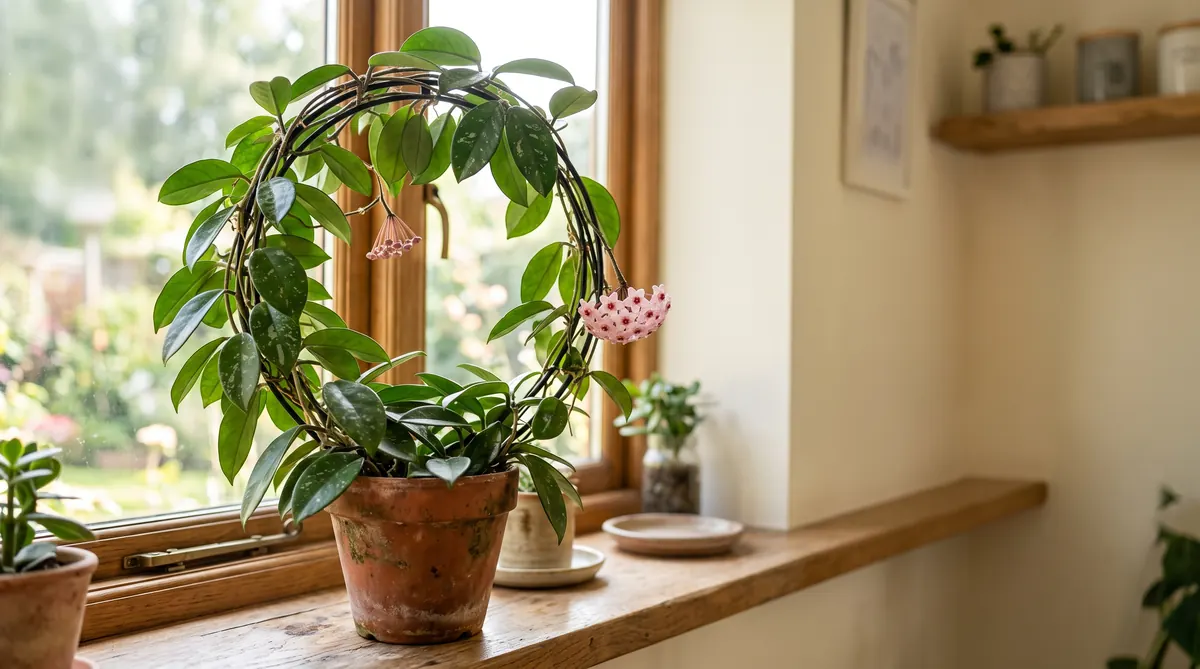
The first time my heirloom Hoya carnosa flowered, I had no idea what was happening. Late on a warm June evening, my living room filled with an intoxicating fragrance resembling toasted vanilla and sweet cocoa. Following the scent to the window, I discovered a perfect sphere of twenty fuzzy porcelain-like star blossoms dripping clear droplets of sugary nectar.
Before that night, I had treated my Hoya like a standard tropical vine, tucking it in a dim corner and watering it weekly. It grew sluggishly, dropped its leafless growth tendrils, and never showed a single flower bud. Once I examined how wild Hoyas thrive in the tree canopies of Southeast Asia and Australia, my entire care approach changed.
Unlike thirsty ground-dwelling plants, Hoyas are true canopy epiphytes equipped with thick, succulent foliage and an efficient drought-adapted metabolism. Understanding how these plants coordinate water storage, climbing mechanics, and flowering spurs makes coaxing endless flushes of fragrant indoor blooms straightforward.
The Science: Nocturnal Breathing, Perennial Spurs, and Sun Stressing
1. CAM Photosynthesis: Why Hoyas Drink Like Succulents
Many thick-leaved Hoya species (including H. carnosa, H. kerrii, and H. obovata) utilize Crassulacean Acid Metabolism (CAM) (Winter et al., 1983; Guralnick & Ting, 1986). In high canopy environments where tree bark dries out rapidly between rains, opening leaf pores (stomata) during the heat of the day causes rapid moisture loss.
Instead, Hoyas open their stomata at night to capture carbon dioxide when temperatures drop and humidity rises. They store this carbon internally as malic acid. During the day, they close their stomata tightly to conserve water, using sunlight to convert the stored acid into sugars. This adaptation gives Hoyas exceptional drought resilience. Saturating the soil when stomata are closed during the day suffocates the root system and promotes rot.
2. The Golden Rule of Peduncles: Why Flower Spurs Are Forever
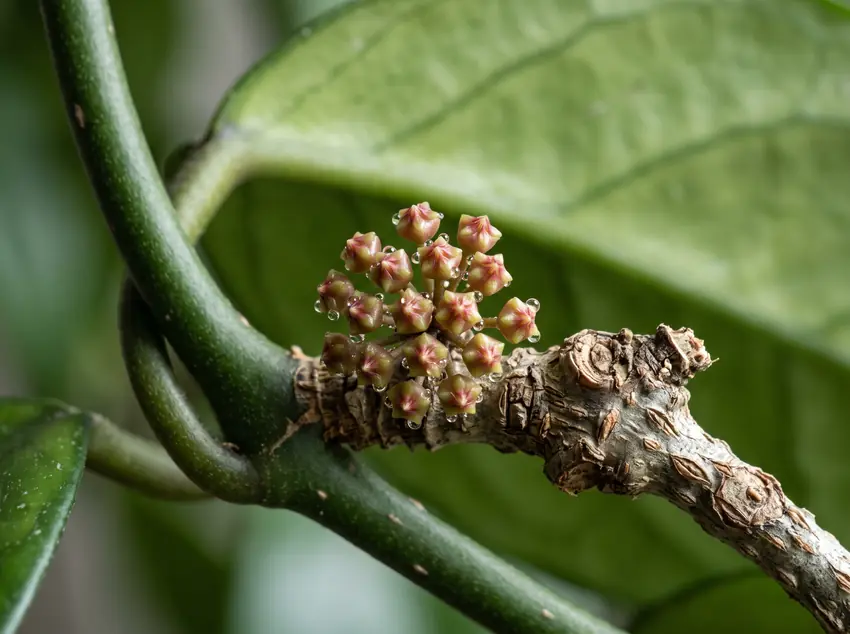
With most flowering houseplants, gardeners prune spent flower stalks to encourage fresh growth. With Hoyas, removing these stalks eliminates future flowering sites. Hoya flower clusters (umbels) emerge from specialized woody stalks called peduncles (Kleijn & van Donkelaar, 2001; Endress & Bruyns, 2000).
Unlike annual flower stems, Hoya peduncles are perennial botanical structures. When individual star flowers drop, the woody peduncle spur stays alive on the vine. Every future bloom cycle develops from this same peduncle, which thickens with each passing year. Cutting off a bare peduncle removes a bloom site capable of producing flowers for decades.
3. Sun Stressing: Anthocyanin Pigments and Photoprotection
When exposed to intense indirect or gentle direct sunlight, many Hoyas (such as Hoya sunrise and Hoya pubicalyx) blush deep shades of bronze, pink, and burgundy. This vivid coloration results from the synthesis of anthocyanin pigments (Gould, 2004).
Anthocyanins function as botanical sunscreen, absorbing excess light radiation and shielding chloroplasts from photo-oxidative stress. Controlled bright light brings out these rich foliage colors and fuels the high energy reserves required for peduncle development.
Everyday Hoya Care: From Vines to Blooms
1. Lighting: The Catalyst for Flowering
When a healthy Hoya produces glossy green vines for years without flowering, the limiting factor is almost always insufficient light. In low light, Hoyas survive strictly as foliage plants. To initiate flower umbels, they need bright indirect light with two to four hours of direct morning or filtered late afternoon sun. An east or west-facing window sill provides ideal photosynthetic energy.
2. Trellising vs. Trailing: The Climbing Advantage
While trailing Hoyas look graceful in hanging baskets, vertical climbing prompts larger leaves and earlier peduncle formation. In nature, climbing vines sense physical support through thigmotropism, routing energy into thicker stems and flower spurs. Guiding long bare vines around a bamboo U-trellis or wire hoop stimulates rapid leaf emergence along previously bare runners.
3. Watering: The Taco Test
Because thick Hoya leaves maintain internal water stores, moisture meters are rarely necessary. Instead, use the gentle “taco test” on a mature lower leaf:
- If the leaf feels firm, rigid, and resistant when gently squeezed between thumb and forefinger, water reserves are full. Hold off on watering.
- If the leaf yields with slight pliability or shows subtle matte wrinkles on the underside, give the pot a thorough, drenching soak.
4. Fertilizing for Blooms: Phosphorus and Micronutrients
During active spring and summer growth, nourish your Hoya with a balanced organic liquid fertilizer diluted to half strength with every other watering. A balanced nutrient profile supports cellular energy for blossom initiation without causing mineral salt burn on delicate epiphytic root hairs. For guidance on avoiding fertilizer salt accumulation, see our complete guide on Fertilizing Tropical Houseplants.
Popular Hoya Species Care Comparison
Compare the distinct growth habits, light preferences, and flower scents of four top home varieties:
| Species / Cultivar | Foliage Character | Sun Stress Ability | Flower Fragrance |
|---|---|---|---|
| Hoya carnosa | Thick, deep green oval leaves with silver flecks | Low (maintains dark green cuticle) | Sweet chocolate, vanilla, and honey |
| Hoya pubicalyx | Long, narrow lanceolate leaves with heavy splash | High (blushes deep purple and bronze) | Spicy floral and sweet musk |
| Hoya kerrii | Large, heart-shaped succulent foliage | Moderate (edges blush light amber) | Subtle burnt sugar and butterscotch |
| Hoya australis | Broad, glossy rounded leaves with fast vine habit | Moderate (new growth emerges bronze) | Intense spicy gardenia and clover |
Troubleshooting Common Hoya Challenges
• Why Are Long, Leafless Tendrils Shooting Out?
Do not cut these bare runners. In nature, Hoyas send out searching scout tendrils to locate physical support before growing leaves. Anchor the tendril to a trellis or hoop, and foliage will develop along the vine within weeks.
• Flower Buds Form and Then Turn Yellow and Drop
Bud blast usually stems from letting the root ball become bone-dry while buds develop, or shifting the pot to a different light angle mid-bloom. Maintain consistent watering and keep the plant stationary once peduncles swell.
• Single Leaf Hoya Kerrii Is Not Growing
Single heart-shaped leaves sold in small novelty pots often lack a portion of the mother stem node. Without axillary meristem tissue from a true node, the leaf can live for years on adventitious roots but cannot generate a growing vine.