Winter Care for Tropical Plants: How to Protect Your Indoor Jungle
The science of winter light loss, cold chilling injury, and how to adjust watering and humidity to keep tropicals thriving until spring.
The “November Panic” Every Plant Parent Experiences
Every year around late November, my plant inbox fills with anxious messages: “My Monstera stopped growing!”, “My Calathea leaves are crisping up!”, and “Why are all my lower leaves turning yellow?” It is easy to see why growers panic. Plants that spent the summer producing lush new leaves every week suddenly look tired and stalled.
During my first winter with tropicals, I tried to “fix” my slow-growing plants by watering them more and feeding them extra fertilizer. It was a disaster that killed three of my favorite plants. Tropical houseplants do not hate winter, but our indoor home environments change drastically once the heating turns on and daylight shrinks. Once you understand the seasonal shifts in light, temperature, and transpiration, keeping your plants healthy through winter is simple.
The Science: Light Drop, Chilling Injury, and Heater Dryness
1. The 50% Daylight Plunge (Daily Light Integral)
In winter, days become shorter and the sun sits lower on the horizon. Photobiology research (Faust & Heins, 1998) shows that the Daily Light Integral (DLI) entering indoor windows drops by 50% to 70% between summer and winter.
Because photosynthesis slows down, the plant requires far less water and stops pushing out new leaves. If you continue pouring summer volumes of water into cold, dark pots, the soil stays wet for weeks, starving roots of oxygen.
2. Chilling Injury: The 55°F (13°C) Danger Zone
Tropical plants evolved in warm equatorial rainforests where temperatures rarely drop below 65°F (18°C). Landmark research on plant chilling stress (Lyons, 1973) shows that when tropical aroid cells drop below 50°F to 55°F (10°C to 13°C), the lipids in cell membranes solidify like cold butter.
This causes cellular leakage, resulting in blackened, water-soaked patches on foliage. Leaves touching freezing window glass or sitting in front of drafty exterior doors suffer instant cold shock.
3. Central Heating and Vapor Pressure Spikes
When home furnaces and radiators turn on, indoor relative humidity often drops below 25%, creating desert-dry air. Atmospheric physics (Allen et al., 1998) shows that this creates a massive Vapor Pressure Deficit (VPD) spike, pulling moisture out of broad leaves faster than cold roots can replace it, causing rapid edge browning.

4 Essential Winter Adjustments for Home Growers
1. Cut Watering Frequency in Half
Because soil dries much slower in winter, your watering schedule must change. If you watered a plant every seven days in July, it may only need water every 14 to 21 days in January. Always check moisture depth by pot weight or with a wooden probe before pouring a drop.
2. Pull Foliage Back from Freezing Glass
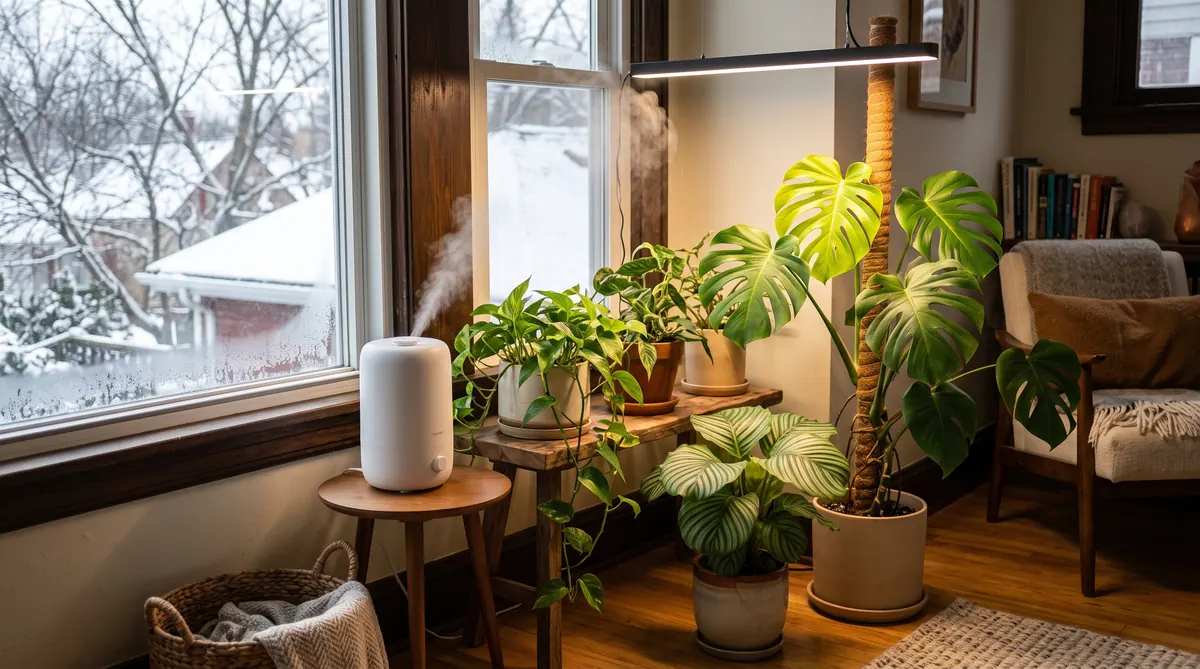
Windowpanes get intensely cold during winter nights. Move your plants just six inches back from the glass so leaves do not make contact with freezing surfaces. If you have drafty window frames, close blinds or sheer curtains at night to create an insulating air barrier.
3. Manage Heating Vents and Radiators
Blasts of hot, dry air from central heating vents will desiccate thin leaves within forty-eight hours. Keep all tropicals at least three to four feet away from active heating radiators or use magnetic air vent deflectors to direct hot air away from plant stands.
To safely maintain healthy ambient humidity levels between 50% and 65% during winter, explore my complete breakdown on Mastering Indoor Humidity: Vapor Pressure Deficit (VPD), Humidifiers, and Misting Myths.
4. Understanding Winter Dormancy on Jewel Aroids
Do not panic if tuberous tropicals (like Alocasias) drop their leaves when temperatures drop in winter. They are simply resting in their underground corm. For steps on keeping dormant corms healthy until spring, visit my guide on Alocasia Polly Care: Corms, Winter Dormancy, and Morning Droplets.
Winter vs. Summer Care Comparison
| Care Factor | Summer Routine | Winter Routine |
|---|---|---|
| Watering | Frequent deep soaks (every 5-8 days) | Reduced frequency; allow deeper drying (every 14-25 days) |
| Fertilizing | 1/4 strength every 1-2 weeks | Pause feeding completely (unless under strong grow lights) |
| Light Placement | Filtered indirect light; protect from midday burn | Move closer to windows; embrace direct gentle winter sun |
| Humidity | Naturally higher ambient humidity | Run humidifier to counteract radiator dryness |
| Pest Monitoring | Watch for fungus gnats in moist soil | Inspect weekly for spider mites thriving in warm dry air |
Troubleshooting Winter Plant Problems
• Blackened, Water-Soaked Patches on Leaf Margins
This is chilling injury from cold drafts or contact with freezing window glass. Move the plant immediately to a warmer location away from glass and drafty doors, and trim the dead tissue with clean shears.
• Yellowing Lower Leaves with Wet, Cold Soil
This indicates winter root rot from overwatering in low light. Move the plant to a warmer, brighter spot, let the soil dry out thoroughly, and wait until spring to repot unless roots are actively rotting.
• Rapid Leaf Dropping and Spider Mite Outbreaks
Dry radiator air stresses foliage and creates ideal breeding conditions for spider mites. Shower the plant in lukewarm water and run a small humidifier nearby to raise relative humidity above 50%.