The Complete Guide to Moss Poles: How Vertical Climbing Creates Giant Leaves
The biomechanics of aerial root feeding, why dry coco coir poles fail, and the simple DIY moss pole setup that doubles your leaf size.
The Difference Between a Trailing Vine and a Jungle Giant
For my first three years of indoor gardening, I grew all my climbing tropicals—like Monsteras, Philodendrons, and Syngoniums—as trailing plants or tied them to dry, brown wooden sticks wrapped in stiff coco fiber. I kept waiting for them to produce the giant, mature leaves I saw in botanical conservatories, but every new leaf stayed small, thin, and juvenile.
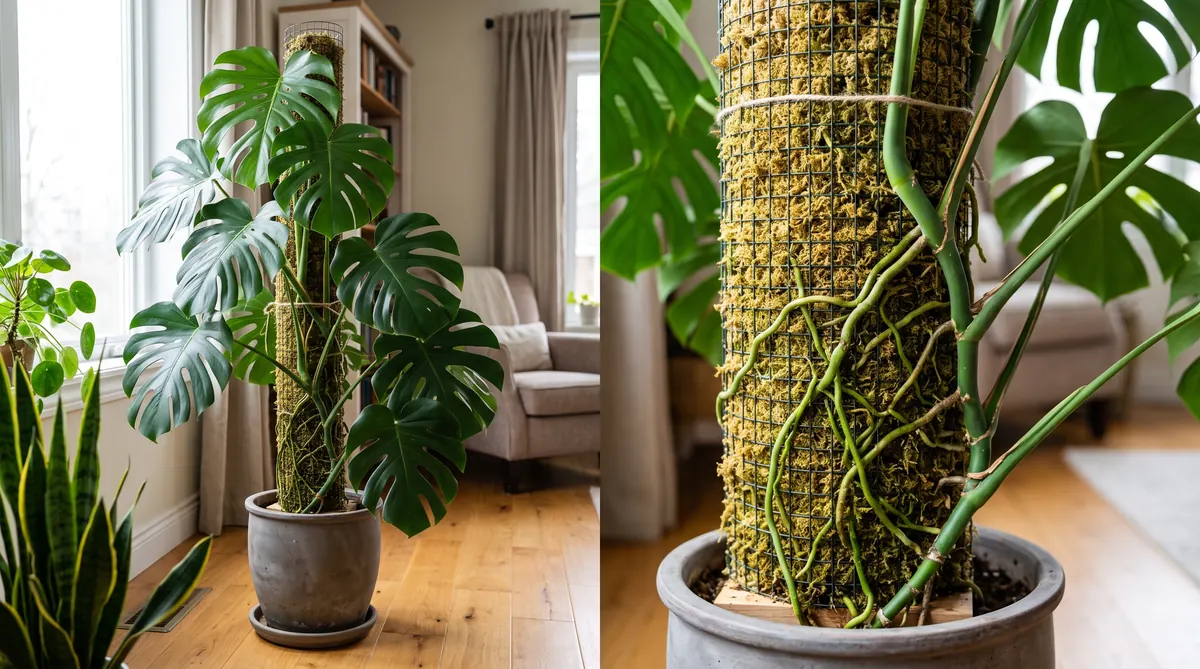
Everything changed when I built my first real, moist sphagnum moss pole. Within four months, my Monstera’s stem doubled in thickness, its aerial roots dug directly into the moss, and the very next leaf emerged with a double row of inner holes. Giving a climbing tropical a moist vertical support is not just decorative: it is the primary biological trigger that tells the plant it is safe to grow into its adult form.
The Science: Biomechanics and the Velamen Sponge
1. How Climbing Triggers Leaf Maturity (Heteroblasty)
In tropical rainforests, aroids begin life on the shaded forest floor as thin, crawling vines. Seminal botanical research by Dr. Thomas Ray (1990) and biomechanics studies (Isnard & Silk, 2009) showed that when a crawling stem makes physical contact with vertical tree bark, specialized touch sensors (thigmotropism) trigger an immediate hormonal shift.
The plant redirects its energy from making long internodes (running across the ground) into thickening its central stem and widening its leaf blades. Each successive leaf becomes wider, more split, and more robust as the plant ascends toward the canopy light.
2. The Velamen Radicum: Aerial Roots Are Secondary Mouths
Aerial roots are not just anchors. Epiphytic biology research (Benzing, 1990; Madison, 1977) proves that aerial roots are covered in a specialized multi-layered epidermis called the velamen radicum.
The velamen acts like a biological sponge: when rain or humidity touches it, dead cell walls expand within seconds, absorbing water and dissolved organic nutrients from tree bark. When your aerial roots grow into a damp moss pole, they branch into thousands of fine feeder roots, effectively giving the plant a second root system that feeds every leaf as it climbs.

How to Build and Maintain a Real Moss Pole at Home
1. Use D-Shaped Wire Mesh (Not Round Cylinders)
The best modern moss poles use plastic-coated wire mesh bent into a “D” shape with a flat plastic backing. The flat plastic back prevents water from evaporating quickly and keeps room walls clean, while the front wire mesh gives aerial roots easy entry into the damp sphagnum moss.
2. Use High-Grade Long-Fiber Sphagnum Moss
Soak high-quality long-fiber sphagnum moss in a bucket of warm water, squeeze out the excess so it is evenly damp like a wrung-out sponge, and pack it firmly into the wire mesh column. Firm packing ensures that growing root tips make direct, continuous contact with moisture.
3. Attaching the Plant: Nodes to the Moss
Position your plant so the back of the stem (where the aerial root nubs emerge) presses directly against the moss face. Secure the main stem using soft plant velcro or stretchy garden tape. Never tie across the petiole (leaf stalk), as petioles must remain free to adjust their angle toward the window.
4. The “Inverted Bottle Trick” for Easy Watering
Misting a moss pole with a spray bottle only wets the outer millimeter, leaving the inside bone-dry. Instead, take a standard plastic water bottle, poke a tiny pinhole in the plastic cap with a heated needle, fill it with water, and invert it directly into the top of the moss pole. Gravity will slowly drip water through the entire length of the pole over twenty minutes with zero runoff.
To see how moss poles work together with pruning techniques for giant leaves on Monstera Deliciosa, explore my guide on Pruning Tropical Houseplants: Apical Dominance, Node Activation, and Bushier Growth.
Support Types Compared
| Support Type | Root Penetration | Leaf Sizing Potential |
|---|---|---|
| D-Shaped Sphagnum Moss Pole | Excellent; roots branch into full root systems inside | Maximum (rapidly triggers mature adult leaf size) |
| Coco Coir Pole | Poor; roots cannot penetrate dry dense fibers | Minimal (provides physical support, but no extra water/food) |
| Cedar / Redwood Plank | Moderate; aerial roots cling to rough wood pores | Good (great for shingling plants like Rhaphidophora) |
Troubleshooting Moss Pole Headaches
• Moss Dries Out in 24 Hours
If your home air is very dry, open mesh cylinders lose moisture quickly. Wrap clear plastic film around the back and sides of the pole, leaving only the front face open where the plant attaches.
• Aerial Roots Grow Around the Pole Instead of In
This happens when the moss inside is dry. Keep the moss consistently damp, and gently tuck emerging root tips into the wire mesh squares so they anchor directly into the moist core.
• Plant Has Outgrown the Top of the Pole
Do not chop your plant! Modern D-poles are designed to be stackable. Simply slide a new moss-filled pole extension into the top of the existing one and secure with cable ties, allowing the plant to keep climbing toward the ceiling.