Fertilizing Tropical Houseplants: The Complete NPK Guide
How to read N-P-K ratios, choose the best nutrients for foliage, and feed your tropicals safely without burning delicate roots.
The Feeding Mistake That Cost Me My Best Leaves
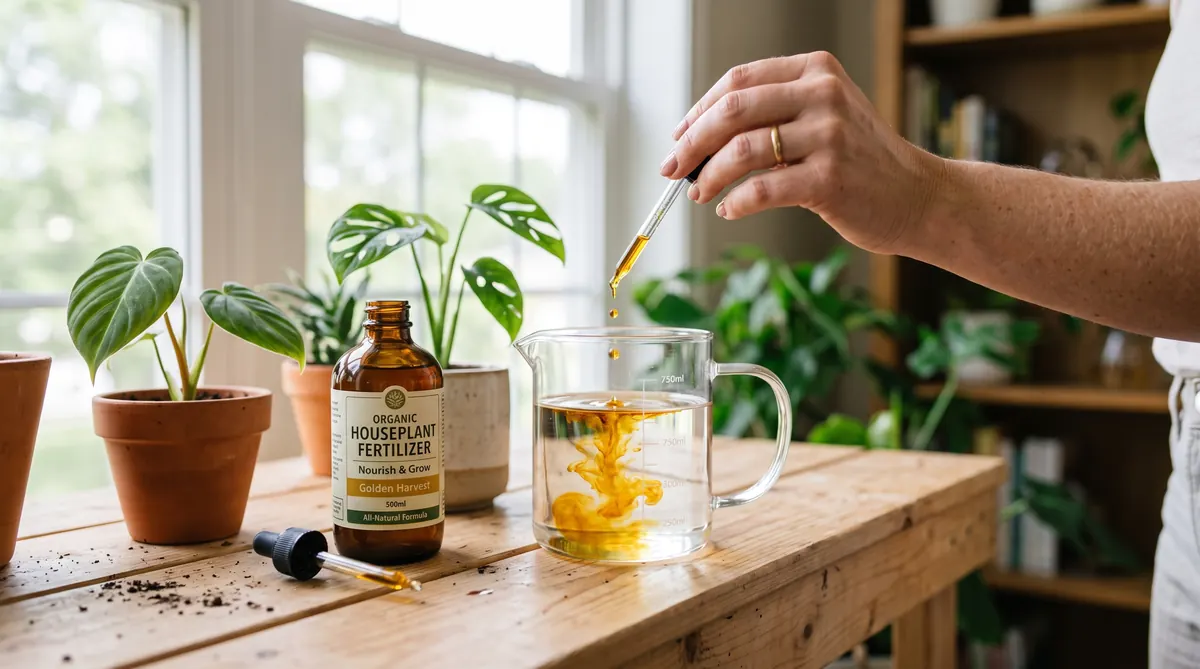
When I bought my first indoor tropicals, I thought fertilizer was like plant food you could pour on whenever you wanted faster growth. One spring afternoon, eager to make my Monstera grow giant leaves, I mixed a heavy scoop of synthetic blue fertilizer into a watering can at full strength and poured it straight into dry soil.
By the following weekend, the tips and margins of almost every leaf had turned crispy black, and two new unfurling leaves died before opening. I had given my plant severe chemical root burn. Plant fertilizers are not food (plants make their own food through photosynthesis); they are mineral building blocks. Once you understand the simple chemistry of how roots absorb minerals, feeding your plants becomes safe, predictable, and remarkably effective.
The Science: Demystifying N-P-K and Micronutrients
1. What the Three Numbers on the Bottle Mean
Every fertilizer label displays three numbers representing the percentage of primary macronutrients (Marschner, 2012; Epstein & Bloom, 2005):
- N (Nitrogen): Powers vegetative foliage growth and the synthesis of dark green chlorophyll molecules.
- P (Phosphorus): Essential for cellular ATP energy transfer, root system expansion, and flowering.
- K (Potassium): Regulates the opening and closing of stomata, governs water pressure, and strengthens plant cell walls against disease.
2. The Ideal Ratio for Tropical Foliage (The 3-1-2 Formula)
Extensive greenhouse research by the University of Florida (Poole & Conover, 1992) found that tropical foliage houseplants consume nutrients in a specific proportional ratio: approximately three parts nitrogen to one part phosphorus to two parts potassium (a 3-1-2 ratio, such as 9-3-6 or 12-4-8).
Many general-purpose fertilizers feature balanced 10-10-10 or 20-20-20 formulas. Because foliage plants consume relatively little phosphorus, high-phosphorus formulas cause unused phosphate salts to accumulate in the potting soil, leading to root stress.
3. Why Chelated Micronutrients Matter
Beyond N-P-K, tropical plants require trace minerals like Iron (Fe), Magnesium (Mg), and Calcium (Ca) for healthy enzyme function. In soilless mixes (like bark and perlite), these micronutrients are scarce. Look for fertilizers that include chelated micronutrients, which keep minerals chemically soluble and easily absorbable across a wide soil pH range.

Everyday Feeding: Practical Rules for Home Growers
1. Never Fertilize Dry Soil
When soil is dry, root cell membranes are slightly shriveled and vulnerable. Pouring concentrated fertilizer onto dry roots draws moisture out of the root cells through reverse osmosis, causing instant chemical burns. Always moisten the soil with plain water first, or mix your fertilizer into your regular watering volume.
2. Heavy Feeders vs. Light Feeders
Fast-growing climbing tropicals with massive foliage, like Monstera Deliciosa and White Bird of Paradise, are heavy feeders that thrive on regular quarter-strength feeding every two weeks in spring and summer. Slow-growing plants, like Parlor Palms and ZZ plants, need feeding only once every six to eight weeks.
3. Winter Feeding Rest
When daylight hours shrink and temperatures cool in autumn and winter, plant growth slows down dramatically. Feeding during winter forces excess mineral salts to sit unused in the pot. Stop fertilizing entirely from November through February unless your plants are growing actively under high-powered LED grow lights.
4. Periodic Soil Leaching (Salt Flushing)
Over time, even careful feeding leaves mineral salt residue in container soil. Every three months, take your plants to the sink or shower and flush the pot thoroughly with plain water to wash away accumulated salts. For step-by-step soil flushing instructions, see my guide on The Science of Watering Tropical Houseplants: Osmosis, Mineral Toxicity, and Flushing.
Seasonal Feeding Cheat Sheet
| Season | Frequency & Strength | Main Objective |
|---|---|---|
| Spring (March – May) | 1/4 strength every 2 weeks (with active growth) | Jumpstart new leaves and root expansion |
| Summer (June – August) | 1/4 strength every 1-2 weeks | Sustain peak photosynthetic leaf production |
| Autumn (Sept – Oct) | 1/4 strength once a month | Taper off feeding as daylight decreases |
| Winter (Nov – Feb) | Zero feeding (unless under grow lights) | Prevent salt buildup and winter root damage |
Troubleshooting Fertilizer Problems
• Crispy Brown Leaf Tips Appearing Days After Feeding
This is direct chemical fertilizer burn caused by excessive concentration or feeding dry soil. Flush the pot immediately at the sink with plain lukewarm water for two minutes to leach out the salts, and pause feeding for one month.
• Pale Yellow Lower Leaves with Green Veins (Chlorosis)
This indicates a micronutrient deficiency, most commonly iron or magnesium. Feed with a balanced liquid fertilizer that includes chelated micronutrients or add a teaspoon of worm castings to the topsoil.
• Weak, Leggy Growth with Tiny Leaves in Winter
If you fertilize when light levels are low, the plant tries to push out growth without enough photosynthetic energy, resulting in frail, stretched stems. Stop feeding until spring daylight returns.