How to Care for Monstera Deliciosa Guide: How Grow Giant Split Leaves at Home
Everything I have learned from years of indoor growing, paired with real botanical research, to help you learn how to care for monstera deliciosa and get massive, hole-filled leaves without the stress.
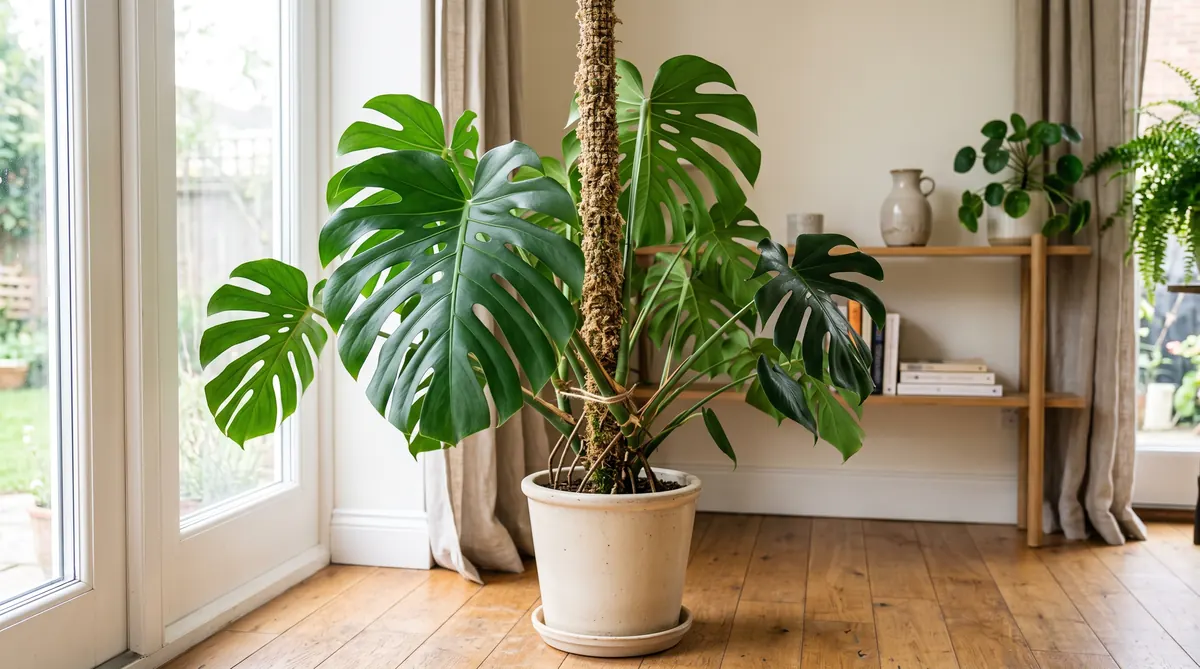
Why We All Fall in Love with the Swiss Cheese Plant
When I brought home my first little Monstera deliciosa in a 6-inch nursery pot nearly eight years ago, it had three small, heart-shaped leaves with zero holes. Like a lot of beginners, I put it on a dark bookshelf, watered it whenever I remembered, and wondered why it looked like an overgrown green vine instead of the lush jungle centerpieces I kept seeing in photos.
It took me a few mistakes and plenty of reading into how these plants actually behave in nature to figure out the secret. Today, that same plant stands over six feet tall in my living room with leaves wider than my torso, packed with double rows of fenestrations (those famous holes). If your Monstera is stuck putting out small solid leaves, or if you are just starting out with your first cutting, do not worry. Once you understand what this plant is looking for, getting those big dramatic leaves is straightforward.
The Science: Why Does Monstera Make Holes in Its Leaves?
In the plant world, those splits and holes are called fenestrations. For a long time, people thought Monsteras developed them to survive hurricane winds. But in 2013, plant ecologist Dr. Christopher Muir published an eye-opening study in The American Naturalist showing the real evolutionary reason: sunfleck capture.
On the floor of the Mexican and Central American rainforests where Monsteras grow natively (Madison, 1977), direct sunlight is rare. Instead, tiny beams of light, called sunflecks, pass through the thick tree canopy above for just a few minutes at a time. Dr. Muir showed that by growing wide leaves with holes in them, a Monstera can cover a much wider surface area using the same amount of plant energy. It gives the leaf a far higher chance of catching those quick rays of sunlight without wasting resources building solid tissue.
Another fascinating study by botanists Strong and Ray (1975) found that wild Monstera seedlings do something almost no other plant does: they grow toward darkness (a behavior called skototropism). Why? Because the darkest spot in a jungle is usually the thick trunk of a tall tree. The plant finds the tree, anchors into the bark, and then starts climbing straight up into the sun. That is why giving your plant a climbing pole at home mimics nature so well.

Everyday Care: What Works in a Real Home
1. Lighting: Where to Put It
Monsteras are often sold as “low light plants.” In low light, your plant will survive, but it will grow long, leggy stems and tiny solid leaves. Place your Monstera two to three feet away from a bright window (east or south-facing windows with sheer curtains work best in most homes). A couple of hours of gentle morning sun directly on the leaves is great; just protect it from harsh, scorching midday summer sun.
2. The Soil: Stop Using Heavy Potting Soil
In nature, Monstera roots grow over bark and moss where fresh air is constantly flowing. When we pack them into regular dense potting soil, water sits at the bottom of the pot, suffocates the roots, and causes root rot. I always mix my own chunky aroid blend at home using orchid bark, chunky perlite, coco coir, and worm castings.
If you want the exact proportions I use for all my climbing tropicals, check out my step-by-step recipe in The Science of Chunky Aroid Soil: DIY Substrate Recipes for Epiphytic Root Health.
3. Watering: The Lift Test
Forget watering on a set day like every Tuesday. Your plant drinks faster during sunny summer weeks and much slower in dark winter months. Water deeply until liquid runs freely out of the drainage holes, then let the top half of the pot dry out before watering again.
My favorite way to check is simply picking up the pot: when it feels light and airy, it is time for a drink. If it feels heavy, wait a few days.
4. Moss Poles: The Fast Track to Huge Leaves
As your Monstera grows, you will see thick brown aerial roots shooting out from the stem. In the wild, these roots grab onto tree bark to pull the plant upward and suck up rainwater and humidity. If you let your Monstera sprawl across the floor, it stays in its juvenile phase. When you give it a vertical moss pole to climb, the plant receives the physical signal that it has found a tree, and every new leaf grows noticeably larger than the last.
To see how to set up and keep a pole moist indoors, read my complete guide on The Complete Guide to Moss Poles: Aerial Root Hydration and Vertical Leaf Sizing.
Quick Care Cheat Sheet
| Care Factor | What Works Best | What to Watch Out For |
|---|---|---|
| Light | Bright, indirect light near a good window | Dim corners lead to small, unslit leaves |
| Watering | Thorough soak when the top 50% is dry | Never let the pot sit in standing water trays |
| Temperature | Comfortable room temp (65°F to 80°F / 18°C to 27°C) | Keep away from cold drafty doors and air conditioners |
| Humidity | Average home humidity (50% to 65% is ideal) | Dry winter air can cause new leaves to catch or rip |
| Feeding | Diluted balanced fertilizer once a month in spring/summer | Over-fertilizing causes brown, crispy leaf tips |
Troubleshooting Common Monstera Headaches
• Yellow Lower Leaves & Soft Soil
This usually means the roots are staying wet for too long. Let the soil dry out more between waterings. If stems feel squishy, check the roots and repot into a chunkier mix with good drainage holes.
• Brown Spots with Yellow Halos
These spots often point to a fungal or bacterial issue caused by water sitting on the leaves combined with poor air circulation. Wipe leaves dry, avoid misting, and place a small fan in the room for gentle airflow.
• New Leaves Are Not Splitting
Your plant is telling you it wants more light and something to climb. Move it closer to a bright window and attach the main stem to a moss pole.