The Complete Fiddle Leaf Care Guide: Light, Water & Branching
Why this dramatic jungle tree drops lower leaves when moved, how to fix red freckles on new foliage, and the exact steps to turn a single stem into a full, branching indoor tree.
The Nursery Tree That Lost Half Its Leaves
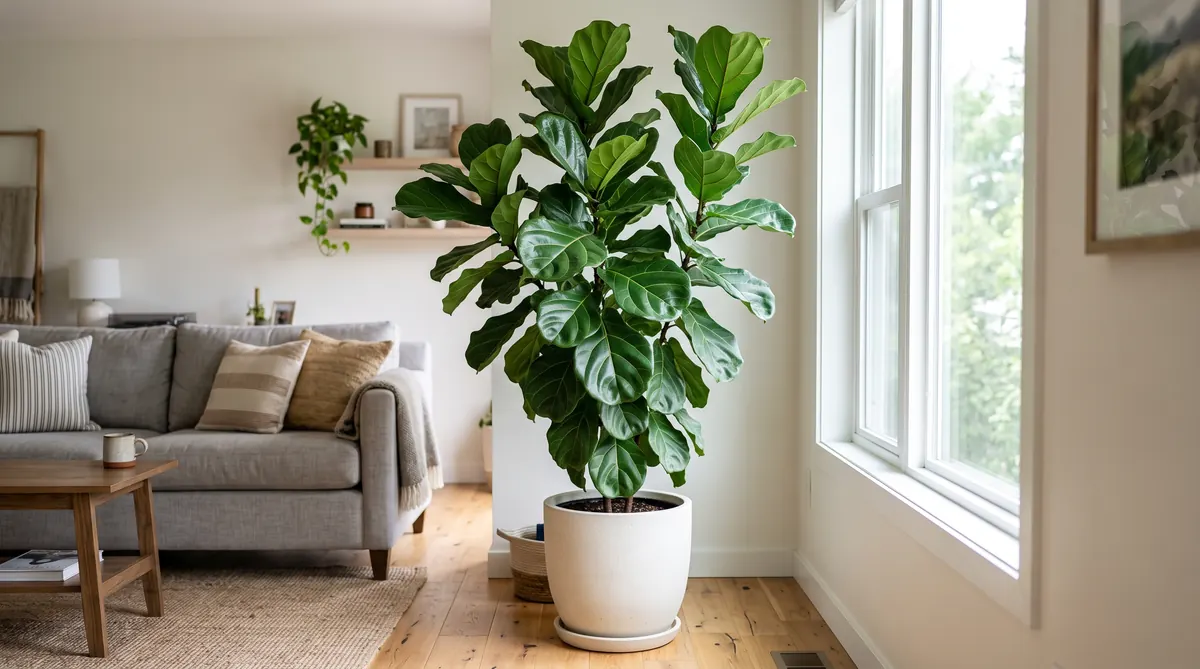
Six years ago, I brought home a magnificent six-foot Ficus lyrata from a local greenhouse. It had enormous, glossy, violin-shaped leaves from top to bottom. I placed it in the corner of my dining room, stepped back, and felt like an interior design genius.
Two weeks later, the nightmare began. Every morning when I walked downstairs, another dinner-plate-sized leaf lay flat on the floor. Within forty days, the bottom third of the trunk was completely bare. When new leaves finally sprouted at the top, they arrived speckled with tiny red dots that looked like an aggressive insect infestation.
I almost dragged it out to the curb. Instead, I started reading into the biology of West African lowland rainforest trees. Once I understood how Ficus lyrata handles light energy and internal water pressure, everything clicked into place. Today, that tree is a sturdy, multi-branched centerpiece that has not dropped a green leaf in four years. If your Fiddle Leaf Fig is testing your patience, do not give up on it. Once you give this plant what its genetics require, it becomes one of the most reliable trees in your home.
The Science: Light Acclimation, Turgor Pressure, and Notching
1. The Light Compensation Point and Sudden Leaf Drop
Why do Fiddle Leaf Figs drop healthy green leaves right after being moved? Research by horticulturists Conover and Poole (1975) showed that tropical foliage trees grown in bright commercial nurseries build thick “sun leaves” designed for intense light. These leaves maintain a high Light Compensation Point (LCP), which is the light intensity where photosynthesis creates the exact amount of energy the plant consumes during cellular respiration.
When you move that tree into a dimmer room, light drops below its LCP. The lower leaves begin consuming more energy than they produce. To keep the rest of the tree alive, the plant produces ethylene gas at the base of the leaf stem and cleanly sheds the unprofitable foliage. The tree drops those leaves as a calculated survival response to light starvation.
2. Oedema: The Mystery of Red Freckles on New Leaves
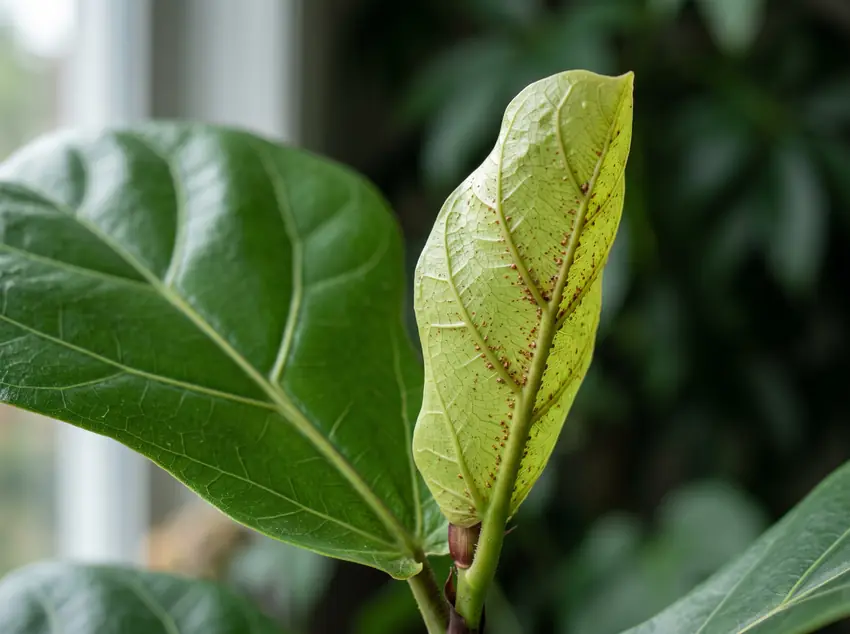
When brand-new unfurling leaves emerge covered in tiny red or rust-colored speckles, hold off on spraying pesticides. This physiological condition is oedema (or edema) (Craver & Nemali, 2019; Morrow, 1952).
Oedema occurs when roots absorb water faster than the young, developing leaf can transpire moisture into the surrounding air. The excess fluid builds hydrostatic turgor pressure inside the delicate leaf cells until they rupture and release reddish anthocyanin pigments. As the leaf expands and hardens, these burst cells turn into small, harmless brown speckles. Oedema is a physical water-pressure imbalance from erratic soil moisture rather than a contagious pathogen.
3. Apical Dominance: How Notching Forces New Branches
Most Fiddle Leaf Figs grow straight up toward the ceiling as a single unbranched pole due to apical dominance (Cline, 1997). The highest growing tip produces auxin, a plant hormone that moves downward through the stem and chemically suppresses lower dormant buds.
Cutting a small horizontal notch through the bark about one-third of the way around the trunk above a dormant node interrupts this auxin flow. Cytokinin hormones moving upward from the roots then activate the dormant axillary bud, prompting the tree to sprout a new lateral branch.
Everyday Fiddle Leaf Care: How to Keep Your Tree Thriving
1. Lighting: The South Window Sweet Spot
In West Africa, Ficus lyrata grows into an energetic canopy tree. Indoors, it requires substantial light. Place your tree directly in front of your largest unobstructed window, where it can enjoy three to four hours of direct morning or filtered afternoon sun. Keeping this plant five feet away from a window in a dim alcove deprives it of usable photons.
2. Soil and Pot Drainage: Oxygen at the Root Core
Fiddle Leaf Fig root systems require active gas exchange (Snyder et al., 2003). Standard dense potting soil compacts and creates saturated, airless zones that drown roots. Blend standard potting soil with 30% coarse perlite and 20% orchid pine bark. Choose pots with drainage holes at the base, and empty catch saucers after watering.
3. Watering: The Wooden Skewer Method
Avoid watering on fixed weekly schedules. Insert a long wooden skewer or chopstick down into the center of the root ball near the main trunk. Withdraw it and check the wood:
- If the top 2 to 3 inches of the skewer emerge dry while the tip feels slightly cool, give the plant a thorough soak until water drains from the pot.
- If damp soil clings to the upper half of the skewer, check back in three to four days.
4. Branching and Pruning: Notching vs. Pinching
When your tree grows too tall without branching, you have two practical options. You can pinch out the apical growth tip in early spring to encourage side shoots, or you can notch the trunk above target nodes to dictate exactly where branches appear. For detailed diagrams and cutting methods, see our guide on Pruning Tropical Houseplants.
Diagnostic Reference: Oedema vs Root Rot vs Bacterial Spot
Use this reference table to identify what your Fiddle Leaf Fig leaves are communicating:
| Symptom Profile | Physiological Oedema | Overwatering / Root Rot | Bacterial Leaf Spot |
|---|---|---|---|
| Spot Location | Brand new unfurling top leaves | Oldest, lowest bottom leaves | Anywhere on the canopy |
| Color & Texture | Tiny red/rust pinpoints; smooth texture | Large dark brown/black patches from edges inward | Irregular brown spots with bright yellow halos |
| Leaf Drop Risk | Very low (leaf expands and stays attached) | High (leaves drop quickly with yellow stems) | Moderate to high if infection spreads |
| Primary Solution | Stabilize watering frequency and improve light | Inspect roots, aerate soil, reduce watering | Isolate plant, prune infected tissue, stop foliar misting |
Troubleshooting Common Fiddle Leaf Fig Frustrations
• Why Are Lower Leaves Dropping After Moving the Pot?
Fiddle Leaf Figs adjust their chloroplast orientation to a specific light angle. Rotating or moving the tree drastically forces older leaves below their light compensation point, triggering rapid shedding. Keep the plant in one bright spot and rotate only 45 degrees once a month.
• The Main Trunk Is Skinny and Wobbles
In the wild, wind movement strengthens tree trunks through thigmomorphogenesis, which stimulates lignin production and wood density. Gently shake your tree trunk for 30 seconds weekly or place an oscillating fan nearby to build a thick, self-supporting stem.
• Large Leaves Are Covered in Grey Dust
Due to their broad surface area, Fiddle Leaf Fig leaves accumulate household dust that blocks incoming light. Wipe both sides of every leaf with a damp microfiber cloth monthly to keep stomata clear and maximize photosynthesis.