How To Master Syngonium Podophyllum Care At Home: From Bushy Vine to Giant Climber
Why the modest nursery arrowhead plant is actually a dramatic botanical shape-shifter, and how vertical climbing triggers its mature five-lobed canopy form.
The Small Nursery Plant That Transformed
Nearly everyone who gets into houseplants starts with an Arrowhead Vine. I picked up my first Syngonium podophyllum ‘White Butterfly’ at a garden center checkout counter for five dollars. It was a compact, bushy mound of pastel-green arrow-shaped leaves sitting on a small side table.
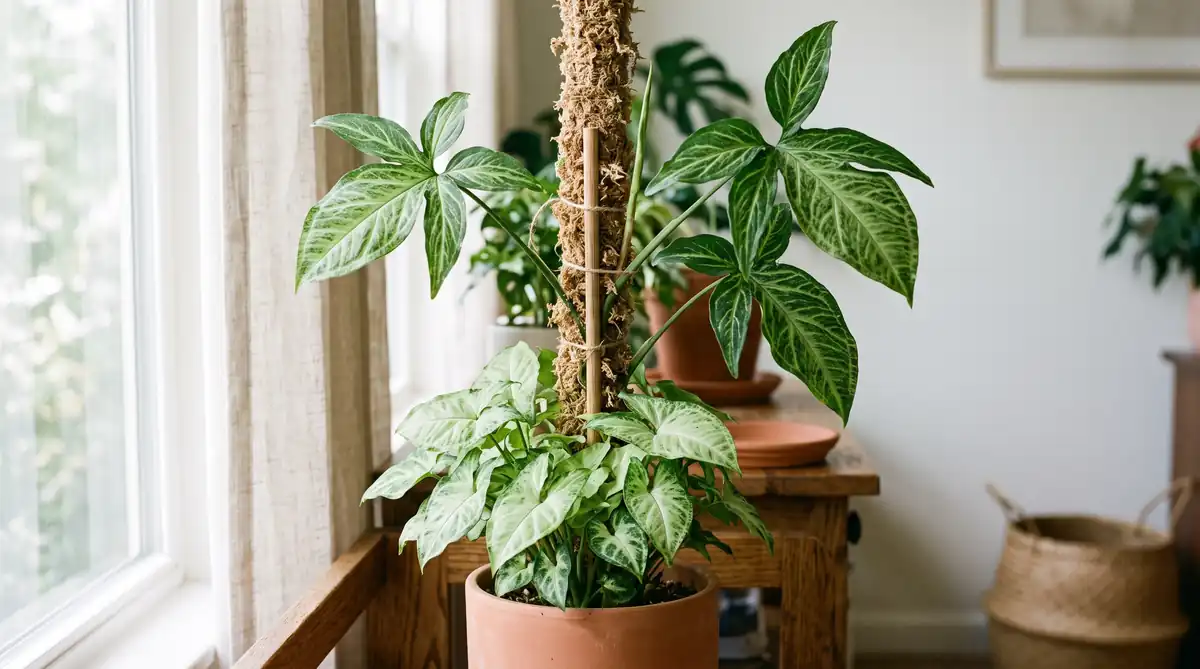
For two years, I trimmed back the long creeping runners to preserve that tidy tabletop shape. Then one summer, I attached one of those wild runners to a moist cedar plank moss pole and set it near an east-facing window. Over the next four months, the plant changed completely. The new leaves grew significantly larger and altered their anatomy. The simple arrowhead split into three distinct leaflets, then five, unfurling as broad, hand-shaped tropical fans that looked like a completely different species.
That experience introduced me to the shape-shifting biology of the genus Syngonium. Arrowhead vines offer far more than starter tabletop greenery. With simple vertical support and consistent light, you can turn an everyday starter plant into an impressive climbing showpiece.
The Science: Heteroblasty, Darkness-Seeking Shoots, and Leaf Lobing
1. Heteroblasty: The Botanical Shape-Shifter
In botany, a dramatic change in leaf structure and growth habit throughout a plant’s lifespan is called heteroblasty (Ray, 1990; Croat, 1981). Syngonium podophyllum is one of the clearest examples in the aroid family.
On the forest floor, juvenile seedlings produce simple, heart-shaped or arrowhead (sagittate) leaves designed to capture diffuse understory light. When the vine climbs toward the canopy, its hormonal balance shifts. The leaf blades undergo ontogenetic lobing (Lee & Richards, 1991), dividing first into three lobes and eventually into five, seven, or nine distinct pedate leaflets. These divided compound leaves reduce wind resistance in high canopy breezes and allow sunlight to penetrate through to lower foliage layers.
2. Flagellar Shoots and Skototropism: Searching for Trees
When Syngoniums send out long, leafless, wire-thin stems across the floor, they are deploying flagellar shoots (Ray, 1990).
These shoots exhibit skototropism (Strong & Ray, 1975), which is growth directed toward darkness rather than light. In native Central and South American rainforests, the darkest silhouette on the horizon is the trunk of a massive host tree. The runner grows rapidly toward that shadow. Once its adventitious root nodes touch bark, the plant stops producing runners and begins climbing, triggering the shift to adult foliage.
3. Laticifers and Sap Defense
Cutting a Syngonium stem reveals a milky white sap oozing from the wound. These fluid channels are specialized internal vessels called laticifers (Mayo et al., 1997). The latex contains microscopic calcium oxalate crystals and protective alkaloids that deter pests. This defense makes Syngonium resilient against common insects, though growers should wear gloves when trimming and keep pets away from pruned stems.

Everyday Care: Bushy Hanging Basket vs. Vertical Climber
1. Choose Your Growing Style: Bush vs. Vine
Before establishing your care routine, select your preferred growth form:
- The Bushy Tabletop Look: Regularly pinch off trailing runners above a leaf node. This activates lower axillary buds, maintaining a dense, compact mound of juvenile foliage.
- The Giant Climbing Specimen: Fasten active vines to a moist sphagnum moss pole or cedar plank. When aerial roots penetrate the damp core, the plant accelerates its transition to mature multi-lobed leaves.
2. Light: Balancing Pigment and Leaf Size
Syngoniums adapt to moderate indoor light, but bright indirect exposure fuels faster growth and richer variegation. Pastel pink and albino cultivars (like ‘Neon Robusta’ and ‘Albo-Variegata’) require ample indirect light to preserve their color contrast. Protect foliage from harsh midday sun, which bleaches delicate pigments.
3. Soil and Watering Dynamics
Unlike sensitive prayer plants, Syngoniums possess robust root systems that tolerate minor watering variations. Plant them in an airy aroid substrate containing 50% coco coir, 30% perlite, and 20% orchid bark. Water thoroughly once the top two inches of potting mix feel dry, ensuring excess moisture drains freely from the pot.
4. Effortless Propagation: Water and Moss Rooting
Syngonium stems root readily. Each stem node features pre-formed root initials that sprout within ten to fourteen days in water or moist sphagnum moss. For detailed propagation methods, see our guide on Tropical Plant Propagation.
Popular Syngonium Cultivars Compared
Explore popular varieties and their unique foliage characteristics:
| Cultivar | Foliage Color Pattern | Growth Rate | Light Requirement |
|---|---|---|---|
| ‘White Butterfly’ | Pale creamy-white centers with soft green borders | Very fast; prolific branching | Moderate to bright indirect |
| ‘Neon Robusta’ | Dusty pastel pink leaf surfaces with lime green undersides | Moderate | Bright indirect (maintains pink tone) |
| ‘Albo-Variegata’ | Bold sectorial splashes of pure snow white on dark emerald | Moderate to slow | High indirect (prevents brown melt) |
| ‘Mojito’ | Speckled camouflage marbling in lime, dark green, and cream | Moderate | Bright indirect light |
Troubleshooting Syngonium Growth Issues
• Pink Leaves Are Fading to Pale Green
Pink Syngonium varieties produce anthocyanin pigments in response to light. In low-light rooms, the plant replaces pink pigments with chlorophyll to maximize light capture. Move the plant closer to an east window to bring back rich pastel tones.
• The Center of the Plant Looks Leggy and Bare
As vines lengthen, apical dominance directs energy to the growing tips, leaving the base sparse. Cut back long stems by half and root the cuttings in water. Once rooted, plant them back into the pot base to restore a full, bushy canopy.
• Mature Plant Is Reverting to Simple Arrowheads
When climbing Syngonium vines slip off their support or trail downward past the top of a pole, they undergo cyclic heterophylly. The loss of vertical root contact signals the plant to revert to juvenile arrow foliage. Extend the pole or guide stems upward to maintain mature lobed leaves.