Zamioculcas Zamiifolia Care Guide: The Ultimate ZZ Plant Guide
The botanical science behind Zamioculcas zamiifolia, its potato-like water reservoirs, and how to propagate new plants from a single leaf.

The Ultimate “Set It and Forget It” Tropical
If you think you do not have a green thumb, or if your home has dark rooms with tiny windows, the ZZ Plant (Zamioculcas zamiifolia) is your best friend. A few years ago, I had to travel for five weeks during the summer. I watered my ZZ plant once before leaving and left it in an interior hallway. When I returned, every other plant looked thirsty, but the ZZ plant was sitting there looking as glossy, upright, and green as plastic decor.
It is almost impossible to kill a ZZ plant by neglect. The only way to destroy it is by showing it too much love with the watering can. Once you see what is happening beneath the soil surface, caring for this African tropical becomes effortless.
The Science: Underground Water Reservoirs and CAM Photosynthesis
1. The Potato-Like Rhizome Engine
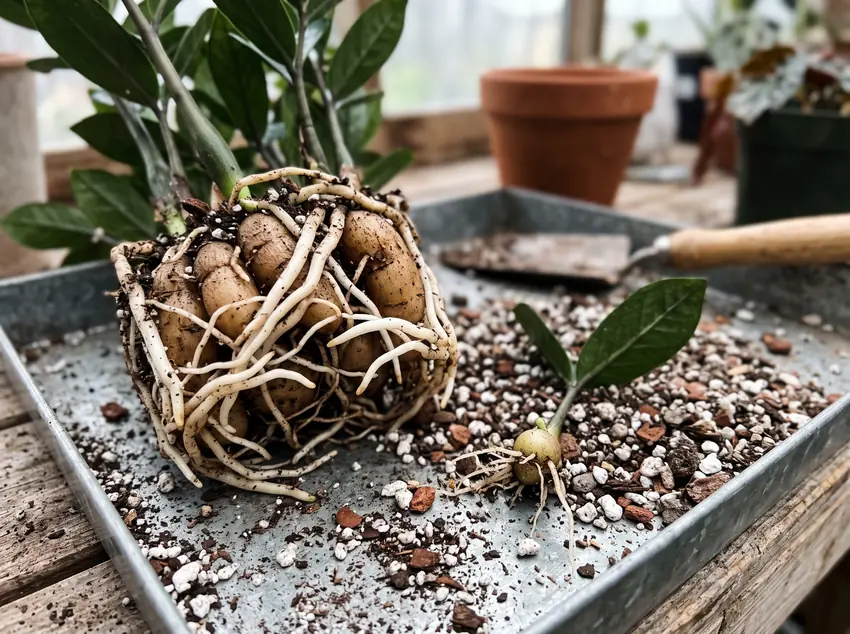
In the dry grasslands and lowland scrub forests of East Africa (Kenya, Tanzania, and Mozambique), Zamioculcas zamiifolia experiences long, brutal droughts where it does not rain for months (Mayo et al., 1997). To survive, the plant evolved thick, tuberous underground stems called rhizomes that look like small potatoes.
These rhizomes, along with the swollen bases of the upright leaf stalks (petioles), act as biological water storage tanks, storing over 90% water by weight. When the soil is dry, the plant draws moisture from its underground reservoir to keep its leaves firm and shiny.
2. Nighttime Breathing (Facultative CAM Photosynthesis)
Most tropical plants open their stomatal pores during the day to take in carbon dioxide for photosynthesis, which loses water through transpiration. Research by plant physiologists (Holtum et al., 2007) showed that the ZZ plant has a secret weapon: facultative Crassulacean Acid Metabolism (CAM).
When well-watered, it photosynthesizes normally like a rainforest plant. But when drought strikes, it switches into CAM mode: keeping its pores tightly closed all day to lock in moisture, and opening them only in the cool of the night to capture carbon dioxide. This dual metabolism is why it survives in dry indoor environments where other plants wither.
The Everyday Zamioculcas Zamiifolia Care Routine for Home Growers
1. Lighting: From Dim Corners to Sunny Rooms
The ZZ plant is legendary for its ability to live in deep shade, dark hallways, and windowless offices. In low light, it will maintain its dark green color with very slow growth. If you give it medium to bright indirect sunlight, it will grow much faster and produce multiple new stems every spring. Just keep it away from harsh, magnifying midday summer sun.
2. Watering: The Neglect Schedule
In most homes, watering once every three to four weeks in spring and summer, and once every six to eight weeks in winter, is plenty. Always drench the pot thoroughly until water flows out the bottom, empty the drip tray so it never sits in water, and do not water again until the soil is completely bone dry all the way to the bottom.
For more details on managing watering cycles and avoiding waterlogged root hypoxia, explore The Science of Watering Tropical Houseplants: Osmosis, Mineral Toxicity, and Flushing.
3. Chunky, Free-Draining Substrate
Because the rhizome is prone to rot in soggy soil, use a cactus-and-succulent mix or blend 50% regular potting soil with 30% perlite or pumice and 20% coarse orchid bark. This ensures that excess water drains out within seconds of pouring.
4. The Leaflet Propagation Miracle
Most aroids require a stem node to propagate, but the ZZ plant is one of the rare plants that can regenerate from a single detached leaflet (Seneviratne et al., 2013). Snip a healthy leaflet, let the cut edge callous over for two hours, and insert the bottom third into damp soil or water.
Within two to three months, the cut end of the leaf will form a tiny, pea-sized rhizome and sprout roots. To see step-by-step photos of this process, read my complete guide on Tropical Plant Propagation: Stem Nodes, Air Layering, and Water-to-Soil Transitions.
Quick Care Cheat Sheet
| Care Factor | What Works Best | What to Watch Out For |
|---|---|---|
| Light | Low to bright indirect light (adaptable anywhere) | Direct hot summer sun will scorch the glossy leaves |
| Watering | Let soil dry 100% before watering (every 3-6 weeks) | Frequent watering causes underground rhizome rot |
| Soil Type | Fast-draining mix with 30-40% perlite and bark | Dense moisture-holding soils stay wet far too long |
| Temperature | 65°F to 85°F (18°C to 29°C) | Avoid prolonged cold below 50°F (10°C) |
| Potting Up | Repot only when the rhizomes warp the plastic pot | Oversized pots hold too much moisture around roots |
Troubleshooting Common ZZ Plant Problems
• Yellowing Stems that Feel Squishy at the Base
This is the classic sign of overwatering and rhizome rot. Unpot the plant immediately, discard the soggy soil, cut away any soft, smelly, or blackened rhizomes with sterile shears, and repot the remaining firm tubers into dry, chunky mix.
• Wrinkling on Stems and Lower Leaflets
If the stems look shriveled and wrinkled like dried fruit, your plant has completely depleted its underground water reservoir. Give it a thorough, deep soaking, and the stems will plump up within twenty-four hours.
• New Stems on ‘Raven’ ZZ Are Lime Green
Do not worry: this is completely normal! New stems on Raven ZZ always emerge bright lime green and gradually darken to deep near-black over six to eight weeks as the plant synthesizes anthocyanin pigments.