Pruning Tropical Plants: The Science of Bushy Growth and Node Activation
How plant growth hormones work, how to use stem notching to wake up dormant nodes, and why regular pruning makes fuller houseplants.
Overcoming the “Fear of the Shears”
For a long time, the idea of taking a pair of shears to my houseplants terrified me. I had spent months watering, babying, and caring for every single leaf, so cutting off a healthy stem felt almost criminal. The result of that fear was a living room filled with long, gangly, single-stem plants that looked thin, bare at the base, and awkward.
The breakthrough came when I understood plant hormone biology. Tropical plants are biologically designed to be pruned. In nature, falling tree branches, grazing animals, and heavy storms regularly trim stems, and plants evolved powerful hormonal pathways to respond by growing back bushier, stronger, and more resilient. Once you understand how growth hormones work, pruning becomes your most powerful tool for shaping stunning indoor greenery.
The Science: Apical Dominance and Cytokinin Activation
1. What is Apical Dominance? (The Auxin Signal)
At the very tip of every growing vine or branch sits the terminal bud. This tip constantly synthesizes a powerful plant growth hormone called auxin (IAA) (Cline, 1991). Auxin flows downward through the stem tissues in a one-way highway.
As auxin travels down, it acts as a biochemical brake, actively suppressing the growth of all the dormant “growth eyes” (axillary buds) located at the lower stem nodes. This evolutionary mechanism is called apical dominance: it forces the plant to spend all its energy racing straight upward toward the forest canopy light rather than branching out wide.
2. What Happens When You Snip the Tip? (Cytokinin Release)
When you prune off the terminal shoot tip, you instantly cut off the downward flow of auxin. Plant physiology studies (Shimizu-Sato et al., 2009) show that with auxin removed, root-produced hormones called cytokinins rush into the dormant lateral buds below the cut.
Without the auxin brake holding them back, those dormant nodes wake up and push out two to three new branching stems. Instead of one thin vine climbing upward, your plant produces multiple vigorous side branches, creating a lush, dense canopy.

3 Essential Pruning Techniques for Home Tropicals
1. “Pinching” for Trailing Vines
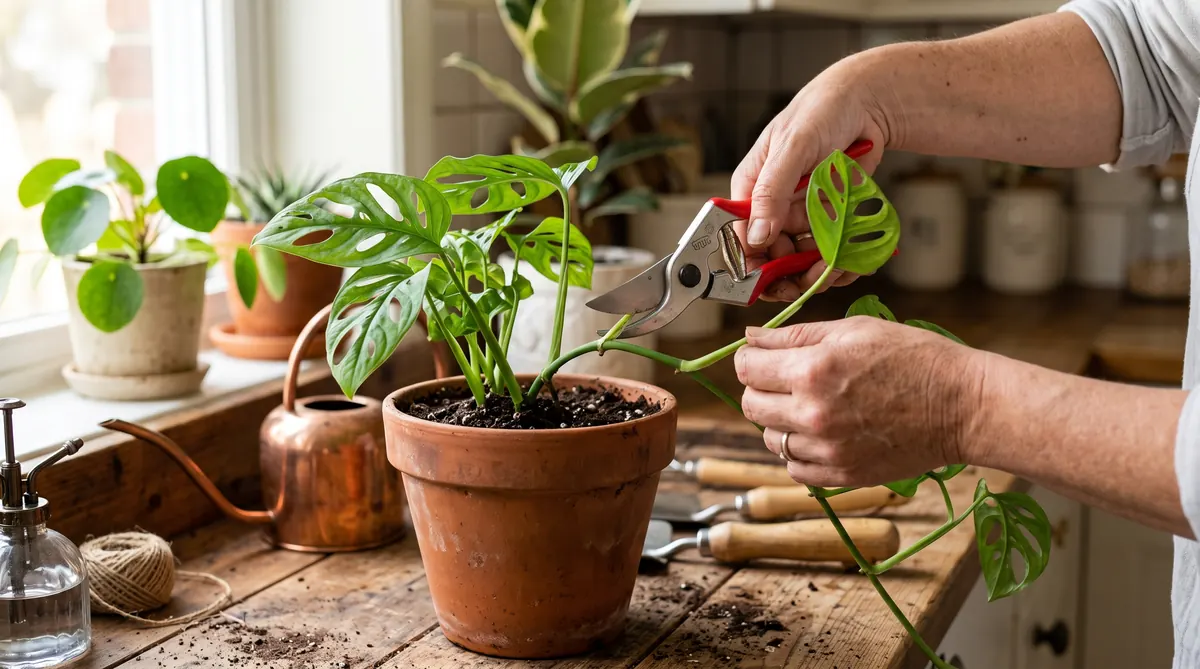
For fast-growing trailing plants like Heartleaf Philodendron, Pothos, and Syngoniums, simple finger pinching works wonders. Use your fingernails or small snips to pinch off the newest tiny leaf bud at the tip of each vine during spring. This halts forward elongation and forces the vine to branch out from lower leaf nodes.
2. Cutting Back Leggy Stems (The 1/4-Inch Rule)
When cutting back long, bare stems, always make your cut 1/4 inch above a healthy leaf node (Shigo, 1984). Cutting too close damages the sensitive nodal growth cells, while leaving a long stub invites fungal dieback. Cut at a clean 45-degree angle so moisture slides off the wound.
3. Replanting Cuttings into the Top of the Pot
Never throw away the healthy stems you trim off! Root your cuttings in water or perlite, and once they develop roots, plant them directly into the top of the mother pot. This creates a dense, multi-stem display that looks twice as full.
To master root organogenesis and transition cuttings without shock, explore my step-by-step tutorial in Tropical Plant Propagation: Stem Nodes, Air Layering, and Water-to-Soil Transitions.
4. Tool Sanitation: The Non-Negotiable Step
Dirty pruning shears are the number-one way viral diseases and bacterial leaf spots spread through indoor collections. Always wipe blades with 70% isopropyl alcohol or a sanitizing wipe before pruning and between different plants.
Pruning Guide by Plant Type
| Plant Group | Best Pruning Method | Ideal Timing |
|---|---|---|
| Trailing Vines (Philodendron, Pothos) | Pinch tips or cut back leggy vines 1/4 inch above node | Spring and early summer during active growth |
| Indoor Trees & Woody Stems (Ficus, Rubber Tree) | Stem notching or apical decapitation for branching | Early spring when sap flow and light increase |
| Climbing Aroids (Monstera, Syngonium) | Air layer top cutting or prune overgrown side shoots | Spring through mid-summer |
| Clumping Foliage (Peace Lily, Calathea) | Prune dead/yellowing leaves at soil level (no node cuts) | Year-round as needed for sanitary maintenance |
Troubleshooting Pruning Mistakes
• Black Dieback Moving Down the Pruned Stem
This occurs when cuts are made with dull, dirty shears or left with long decaying stubs. Make a fresh, clean cut 1/4 inch above the next lower green node with a sanitized razor or sharp bypass pruners.
• Plant Pushes Out Only One New Shoot After Pruning
If light levels are low, the plant only has enough photosynthetic energy to activate a single growth eye. Move the pot to a brighter window to encourage multiple lateral buds to break simultaneously.
• White Milky Sap Dripping After Cutting Ficus
This latex sap is natural for the Moraceae family. Dab the cut with a damp paper towel or spray with cold water to coagulate the sap quickly, and wash hands to avoid mild skin irritation.