Aphids & Whiteflies on Tropical Plants: 4-Step Eradication
Why aphids multiply without mating, how whiteflies blanket leaf undersides in waxy scales, and the exact steps to eliminate them while preventing black sooty mold.
The Spring Growth Invasion
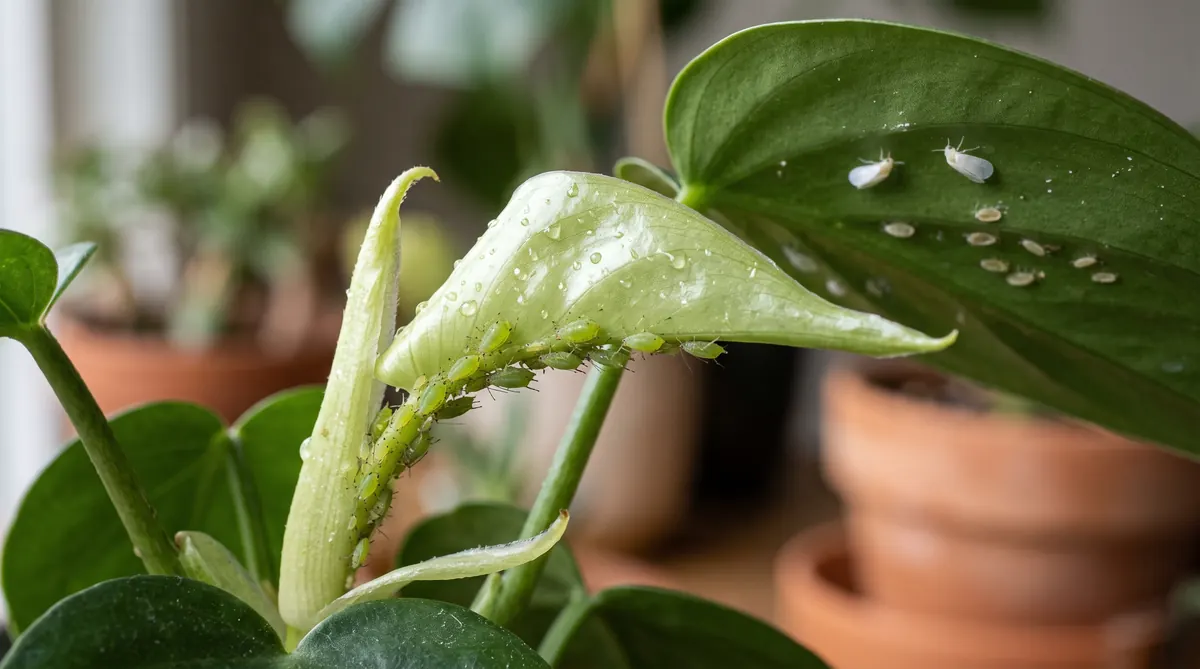
Every spring, indoor growers look forward to a wave of fresh new foliage. A few seasons back, I was admiring a brand-new spear emerging on my Philodendron. When I checked back forty-eight hours later, the entire pale green shoot was coated in a dense, crawling carpet of bright green aphids. Sticky droplets dripped onto the floor, and the tender leaf emerged crinkled, curled, and stunted.
A few weeks later, I touched the broad leaf of my White Bird of Paradise, and a cloud of microscopic white “moths” fluttered into the air before settling right back onto the leaf underside. That was whitefly season in full swing.
Both aphids and whiteflies target the softest, most nutrient-rich growth on your houseplants. Because they reproduce at blistering speeds and excrete sticky honeydew that breeds black mold, ignoring them ruins your plants’ best seasonal growth. Fortunately, their soft bodies make them uniquely vulnerable to simple physical and organic interventions.
The Science: Parthenogenesis, Sap Pressure, and Sooty Mold
1. Telescoping Generations in Aphids (Parthenogenesis)
Aphids possess one of the most astonishing reproductive adaptations in the animal kingdom (Dixon, 1998). Under warm indoor conditions, female aphids do not need to mate. Through parthenogenesis, females give birth directly to live, clone daughters.
Even more extraordinary is a phenomenon called telescoping generations: an unborn female aphid inside her mother already contains developing embryos of her own future offspring inside her body. This nesting-doll biology allows a single pioneer aphid to generate hundreds of descendants in just 10 to 14 days.
2. Whitefly Life Stages and Waxy Scale Nymphs
Whiteflies (family Aleyrodidae, including Bemisia tabaci and Trialeurodes vaporariorum) are not true flies or moths; they are tiny hemipteran sap-feeders (Byrne & Bellows, 1991). Their life cycle features four distinct stages:
- The Eggs: Laid in neat concentric circles or spirals on leaf undersides.
- The Crawlers: Microscopic first-instar nymphs that walk a short distance before inserting their stylets.
- The Sessile Nymphs & Pupae: Flattened, oval, scale-like bodies covered in powdery white wax that stay permanently anchored while feeding.
- Winged Adults: Tiny white insects coated in fine powdery wax that flutter when plants are touched.
3. The Nitrogen Connection & Sooty Mold
Both pests feed on pressurized phloem sap. When home growers use excessive high-nitrogen chemical fertilizers, plants produce an abundance of free amino acids in their sap stream (Inbar & Gerling, 2008). This supercharged sap causes aphid and whitefly reproduction to skyrocket.
As they siphon massive volumes of sap, they excrete surplus sugars as sticky honeydew. Airborne fungal spores of Capnodium land on this honeydew, forming dark black mats of sooty mold that block sunlight and impair photosynthesis.
Diagnosis: Aphids vs Whiteflies vs Scale Crawlers
Distinguish between these sap-suckers with this diagnostic reference:
| Diagnostic Trait | Aphids (*Aphidoidea*) | Whiteflies (*Aleyrodidae*) | Scale Crawlers |
|---|---|---|---|
| Body Shape & Texture | Plump, pear-shaped, soft green, pink, or black bodies | Flat scale-like nymphs; moth-like powdery adults | Tiny amber/yellow oval specks |
| Reaction to Disturbance | Remain clustered on stems; slow sluggish crawling | Adults immediately take flight in white clouds | Crawlers walk slowly; adults are immobile |
| Cornicles Present? | Yes (two small “exhaust pipe” tubes at rear of body) | No cornicles | No cornicles |
| Favorite Feeding Spot | Tender shoot tips, fresh unfurling leaves, flower buds | Undersides of mature broad leaves | Main woody stems and leaf veins |
The 4-Step Aphid & Whitefly Eradication Protocol
Because aphids and whiteflies have fragile, soft exoskeletons, you do not need harsh synthetic poisons to achieve 100% control:
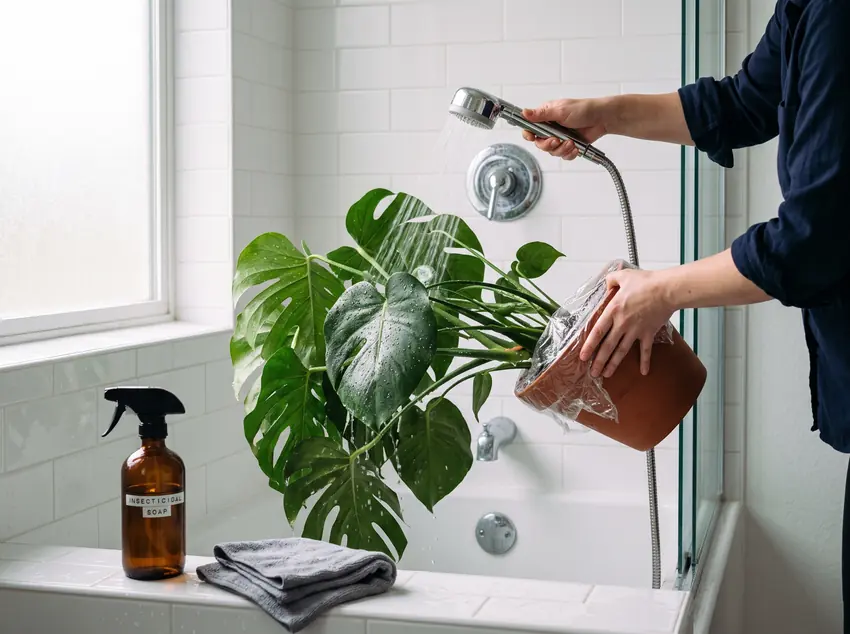
Step 1: The High-Velocity Water Blast
Take the plant to a shower or outdoor hose. Using a narrow spray nozzle at moderate-to-firm pressure, spray directly into aphid clusters and the undersides of leaves. Physical water impact dislodges the pests and snaps their delicate feeding stylets; once an aphid’s mouthparts are broken, it cannot reattach or feed and quickly dies.
Step 2: Saponification & Suffocating Foliar Spray
Once the leaves dry slightly, spray all foliage with an emulsified insecticidal soap solution (1 teaspoon liquid Castile soap + 1 teaspoon horticultural mineral oil or cold-pressed neem per quart of warm water). The potassium salts dissolve the soft cuticle while the oil film blocks breathing spiracles on whitefly nymphs and scale-like pupae.
Step 3: Yellow Sticky Card Aerial Interception
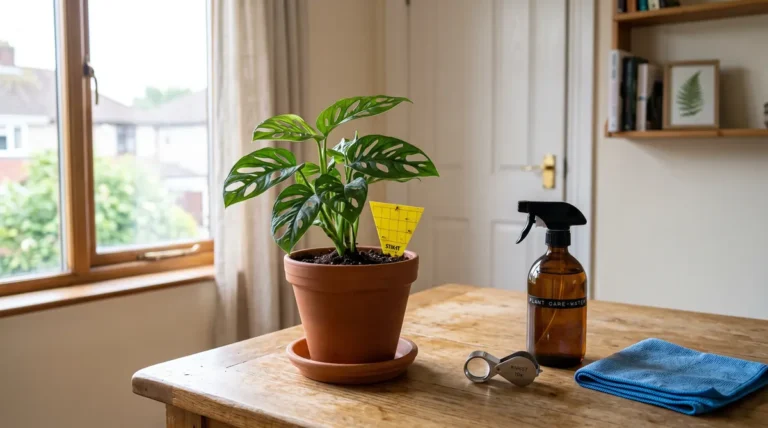
Hang yellow sticky cards directly inside the canopy foliage. Adult whiteflies and winged aphids (alates) are irresistibly drawn to yellow wavelengths. Trapping the flying adults stops them from dispersing to adjacent houseplants and laying new egg spirals.
Step 4: Honeydew & Sooty Mold Wash-Down
Wipe down foliage coated in sticky honeydew or black sooty mold with a microfiber cloth dipped in warm, soapy water. Removing the honeydew instantly restores light penetration to leaf chloroplasts and discourages ant activity.
Troubleshooting Aphid & Whitefly Outbreaks
• Why Did Winged Aphids Suddenly Appear?
When an aphid colony becomes overcrowded or food quality declines, hormonal signals trigger the birth of winged females called alates. This is nature’s cue to disperse. Move the infested plant into quarantine immediately and set up yellow sticky cards.
• Whiteflies Keep Returning Every 5 Days
Whitefly pupae have a waxy protective shell that resists light contact sprays. Repeat your soap and oil emulsion sprays every 4 to 5 days for three full cycles to kill emerging adults before they can lay fresh eggs.
• Ants Are Marching on My Houseplants
Ants “farm” aphids and whiteflies for sweet honeydew, actively protecting them from predatory insects. Place an ant bait station near the pot base and wipe the plant stems to break the ant scent trail.