Powdery Mildew on Houseplants: How I Identify & Stop Spores
Understand the microclimates that trigger powdery white coatings and fuzzy grey rot, and master proven botanical protocols to eliminate fungal spores without damaging delicate foliage.
The Winter Glass Cabinet Epidemic
Two winters ago, I built a converted glass cabinet to house my sensitive tropical collection, including velvet-leaf Begonias, rare Philodendrons, and juvenile Calatheas. I installed a small ultrasonic humidifier set to maintain 80% relative humidity and packed the shelves tightly with over thirty plants.
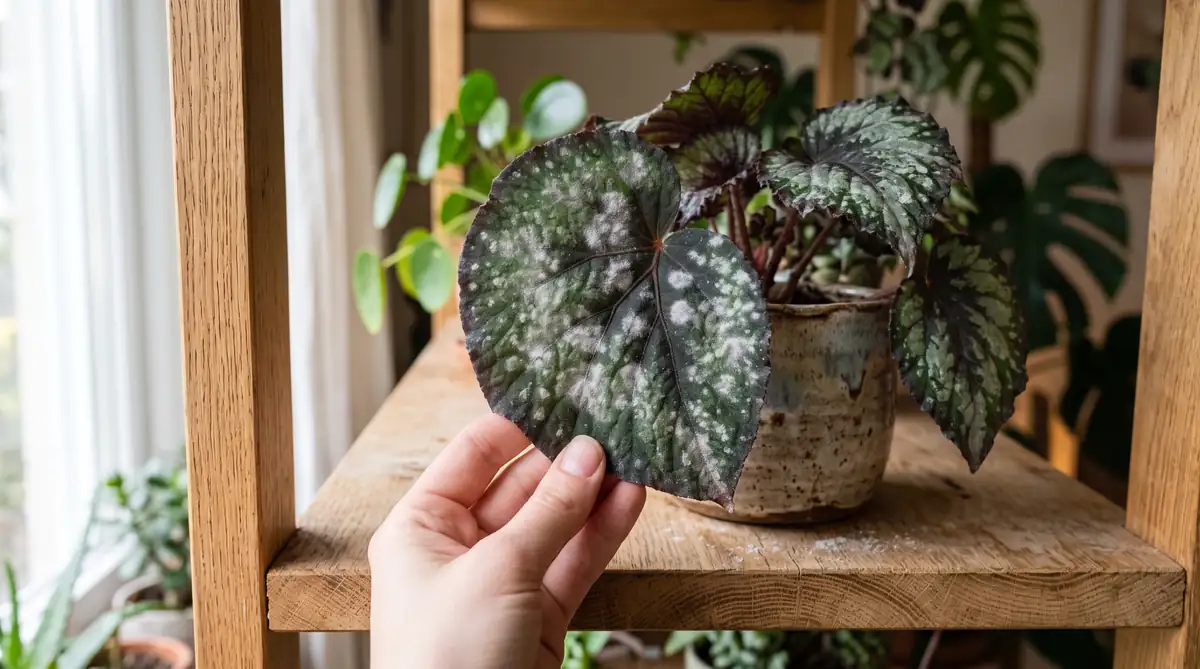
For the first few weeks, the plants looked lush. Then, as outside temperatures dropped in December, I noticed a fine, flour-like white dusting spreading over the leaves of my Begonias. Days later, decaying lower leaves and spent flower stems developed a thick, fuzzy grey coat that puffed clouds of fine dust whenever I opened the cabinet doors.
I had created the textbook breeding environment for two distinct fungal pathogens: powdery mildew and grey mold (Botrytis cinerea). In a tightly sealed enclosure without active air circulation, stagnant boundary layers formed around every leaf. Learning the distinct lifestyles of biotrophic powdery mildews and necrotrophic grey molds transformed how I manage air exchange, canopy spacing, and preventative biofungicides indoors.
The Science: Biotrophic vs. Necrotrophic Lifestyles and Infection Mechanics
1. Powdery Mildew (Erysiphales): The Obligate Biotroph
Powdery mildews belong to the order Erysiphales (Glawe, 2008; Bélanger et al., 2002). They are obligate biotrophic parasites, meaning they require living host tissue to complete their life cycle and do not immediately kill host cells.
The fungal mycelium grows almost entirely on the exterior leaf surface, giving infected foliage its characteristic white, talcum-powder coating. The fungus projects specialized root-like nutrient organs called haustoria through leaf epidermal cell walls to siphon carbohydrates and amino acids. While powdery mildew spores require high relative humidity (above 70%) to initiate germination, standing water droplets on leaves actually inhibit spore viability, making dry foliage under stagnant humid air its ideal niche.
2. Grey Mold (Botrytis cinerea): The Necrotrophic Opportunist
Botrytis cinerea operates on a fundamentally opposite ecological strategy. It is a virulent necrotrophic pathogen that secretes cell-wall degrading enzymes (polygalacturonases and cellulases) alongside phytotoxins to kill host plant cells ahead of infection, feeding exclusively on decaying matter (Williamson et al., 2007; Elad et al., 2016).
Botrytis thrives in cool (55°F to 65°F), damp conditions with persistent relative humidity above 85%. It typically establishes on aging flowers, bruised foliage, or dying lower petioles before spreading aggressively into healthy green stems. The visible grey “fuzz” consists of microscopic tree-shaped structures called conidiophores, each holding thousands of airborne conidiospores ready to disperse on gentle air currents.
3. The Boundary Layer Effect and Microclimates
Even if your room hygrometer reads 50% relative humidity, the stagnant microclimate immediately adjacent to dense leaf clusters (the boundary layer) can exceed 90% humidity. Without continuous laminar airflow, this humid micro-pocket allows fungal conidia to anchor, germinate, and penetrate host tissue undetected.
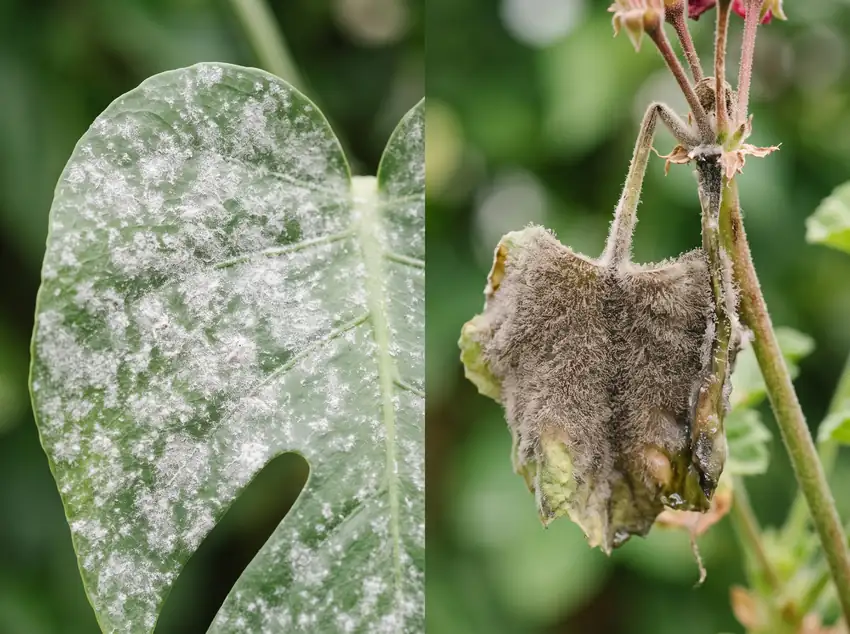
Powdery Mildew vs. Grey Mold: Clinical Diagnosis
Use this diagnostic reference to identify which fungus is affecting your indoor jungle:
| Diagnostic Feature | Powdery Mildew (Erysiphales) | Grey Mold (Botrytis cinerea) |
|---|---|---|
| Pathogen Lifestyle | Biotrophic (Lives on living tissue) | Necrotrophic (Kills and feeds on dead tissue) |
| Visual Appearance | White to light gray talcum powder on leaf surface | Fuzzy brown-grey cobweb growth on dying parts |
| Host Tissue Target | Young leaves, succulent stems, fresh shoots | Senescing flowers, old petioles, wounded stems |
| Primary Environmental Trigger | High humidity with dry leaf surfaces and warm days | Cool temperatures, stagnant damp air, high condensation |
| Primary Organic Treatment | Potassium Bicarbonate, Sulfur, Horticultural Oil | Sanitation excision, Bacillus biofungicide, Airflow |
5-Step Fungal Spore Eradication Protocol
Step 1: Gentle Physical Sanitation
Carefully bag and remove severely covered foliage and spent flowers before spores become airborne. Wipe lightly infected leaves with a damp paper towel soaked in diluted soap water, disposing of the wipe after each leaf.
Step 2: Prune for Canopy Ventilation
Thin out crowded interior stems to open up the canopy. Space individual pots at least 4 to 6 inches apart on plant shelves so leaves from adjacent plants do not overlap.
Step 3: Apply Potassium Bicarbonate Solution
Potassium bicarbonate ($KHCO_3$) alters the leaf surface pH and exerts osmotic pressure that ruptures fungal cell walls (Horst, 2013). Mix 1 tablespoon of potassium bicarbonate with 1/2 teaspoon of liquid horticultural soap in one gallon of water. Spray all leaf surfaces thoroughly, applying in the morning so foliage dries quickly under lights.
Step 4: Deploy Beneficial Biofungicides
Biological inoculants containing Bacillus subtilis or Bacillus amyloliquefaciens colonize leaf surfaces and secrete lipopeptides that inhibit spore germination. Apply biofungicides as a preventative spray every 14 days during winter months.
Step 5: Install Continuous Low-Speed Airflow
Add an oscillating fan or computer-style USB fans inside display cabinets. Constant gentle air movement disrupts boundary layers, stabilizes microclimates, and prevents fungal conidia from establishing on foliage.
Troubleshooting Fungal Inquiries
• Can I Use Baking Soda Instead of Potassium Bicarbonate?
Yes, sodium bicarbonate (standard baking soda) works similarly, but repeated applications can cause sodium toxicity in sensitive foliage. Potassium bicarbonate is preferred because it supplies usable potassium to plant tissues.
• Why Did Powdery Mildew Appear in a Dry Room?
Powdery mildew spores are uniquely adapted to germinate on dry leaf surfaces under humid air. Even in a moderate room, crowded foliage creates dense humidity pockets that support germination without liquid water.
• Does Milk Spray Actually Work Against Powdery Mildew?
Yes. Diluted milk (1 part milk to 9 parts water) exposed to light produces free radicals through lactoferrin breakdown, which damages fungal mycelium. However, potassium bicarbonate solutions are cleaner and odor-free indoors.