Mealybugs and Scale Insects on Tropical Plants: Eradication
Why conventional contact sprays bounce off their hydrophobic wax coats, how 70% alcohol dissolves their defenses, and how systemic treatments clear hidden colonies.
The “Harmless Cotton Fluff” Deception
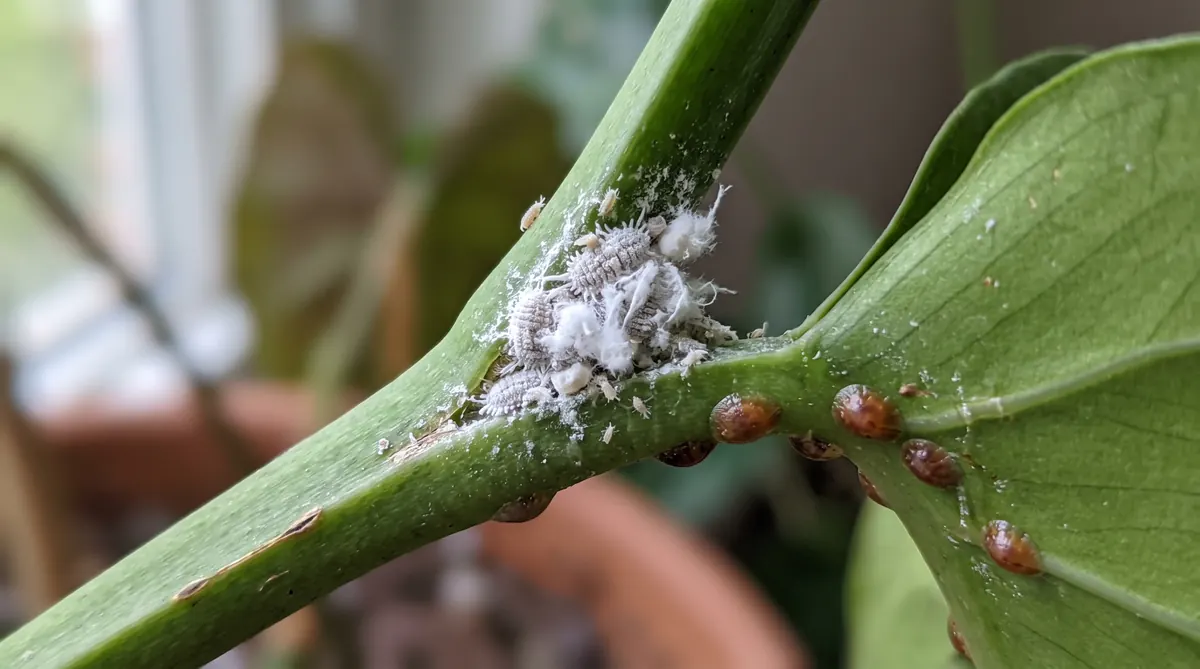
A few years ago, I noticed a tiny dab of white fluff tucked into the leaf axil of a mature Monstera. I assumed it was stray cotton from a Q-tip or a drifting bit of dust. Two months later, sticky sap covered the lower leaves, black mold grew in the puddles, and every petiole sheath housed a thriving colony of segmented, powder-coated bugs.
Mealybugs and their close cousins, scale insects, are master stealth invaders. Because they move slowly or stay anchored in one spot, growers often overlook them until hundreds of nymphs are feeding inside microscopic stem crevices. When you try spraying them with plain water or gentle soap, the water beads up and rolls off their waxy bodies without doing any harm.
To eliminate mealybugs and scale for good, you need to understand the chemical composition of their waxy protective armor. Once you know how to dissolve that lipid shield and pair manual spot treatments with systemic protection, clearing an infestation becomes straightforward and reliable.
The Science: Hydrophobic Wax Armor and Phloem Feeding
1. The Coccoidea Superfamily & Hydrophobic Lipids
Both mealybugs (family Pseudococcidae) and scale insects (families Coccidae and Diaspididae) belong to the hemipteran superfamily Coccoidea (Gullan & Kosztarab, 1997; Cox, 1987). Their evolutionary secret is the production of specialized cuticular secretions.
Mealybugs possess dermal glands that extrude long-chain hydrocarbon waxes, fatty acids, and esters in powdery white threads. Soft scale insects secrete a waxy protective carapace, while armored scale insects build a completely separate, hard, shield-like test out of shed exuviae and proteinaceous wax. This coating is intensely hydrophobic: aqueous sprays simply roll off without penetrating to the insect underneath.
2. Phloem Siphoning, Honeydew, and Sooty Mold
Scale insects and mealybugs insert flexible, thread-like stylet bundles deep into the plant’s vascular system to siphon pressurized phloem sap. Because plant sap contains high amounts of water and sugars but low concentrations of amino acids, these pests process massive volumes of liquid, excreting the surplus sugar as sticky honeydew (Franco et al., 2009).
This sticky residue attracts ants and provides the perfect growth substrate for Capnodium species (black sooty mold), which blankets foliage and blocks sunlight from reaching photosynthetic cells.
Diagnosis: Mealybugs vs Soft Scale vs Armored Scale vs Root Mealybugs
Knowing which type of pest you are dealing with determines whether foliar sprays or root drenches will work best:
| Pest Type | Appearance | Mobility | Primary Location |
|---|---|---|---|
| Foliar Mealybugs (*Pseudococcus*) | Soft, pinkish bodies covered in white cottony wax filaments | Slow crawling throughout entire life | Leaf axils, underside of veins, new shoots |
| Soft Brown Scale (*Coccus hesperidum*) | Smooth, dome-shaped amber/brown oval bumps | Crawlers mobile; adult females permanently sessile | Main leaf veins, woody stems, petioles |
| Armored Scale (*Diaspididae*) | Hard, separable shell (test); produces no honeydew | Crawlers mobile; adults locked under shell | Stems, hard leaf blades, trunk bark |
| Root Mealybugs (*Rhizoecus*) | White chalky deposits and tiny bugs on roots | Slow moving within soil voids | Entirely underground along root ball |

The 4-Step Mealybug & Scale Eradication Protocol
To eliminate these pests, you must attack them from both the outside (dissolving their wax) and the inside (systemic sap uptake):
Step 1: Alcohol Spot Eradication (Manual Debridement)
Dip a cotton swab (Q-tip) in 70% Isopropyl Alcohol (rubbing alcohol). Press the wet swab directly onto visible mealybugs and scale bumps. Alcohol acts as an organic solvent: it instantly dissolves the protective wax coat and denatures the insect’s cellular proteins. The bug will instantly turn from white or brown to a dead yellowish-orange color.
Pro-Tip: Check deep inside unfurling leaf sheaths, along the underside of main leaf veins, and around the drainage holes of the nursery pot.
Step 2: High-Pressure Foliar Wash
After spot-treating visible clusters, take the plant to a shower or hose. Use lukewarm water under moderate pressure to dislodge mobile “crawler” nymphs, rinse off excess alcohol, and wash away sticky honeydew deposits.
Step 3: Suffocating Horticultural Oil Spray
Spray the entire plant thoroughly with a 1% horticultural mineral oil or insecticidal soap solution. While adult wax resists water, oil emulsions coat breathing spiracles and smother microscopic crawler nymphs before they can establish new feeding sites.
Step 4: Systemic Insecticide Soil Drench
Because female mealybugs and scale insects lay hundreds of eggs deep inside stem fissures and root zones where sprays cannot reach, systemic protection is the decisive step (Raupp et al., 2004).
Apply systemic granules containing imidacloprid or dinotefuran to the soil surface and water thoroughly. The plant’s root system absorbs the active compound and translocates it upward through xylem and phloem vessels. Within 5 to 7 days, the entire plant sap becomes toxic to phloem-feeding insects, killing any hidden pests the moment they feed.
Troubleshooting Mealybug & Scale Treatments
• Why Are White Clusters Appearing on Root Balls?
If you unpot a plant and see white, chalky web-like pockets adhering to the roots and inside the pot walls, you are dealing with Rhizoecus (root mealybugs). Wash away all soil, submerge the root system in an insecticidal soap or peroxide bath, and repot in fresh substrate with systemic granules.
• Can I Spray Undiluted Rubbing Alcohol on Leaves?
Pure 70% alcohol is safe for direct Q-tip spot application on thick-leaved plants like Monsteras and ZZ Plants. However, if you plan to mist an entire plant, dilute it to a 1:4 ratio (1 part alcohol to 3 parts water) to prevent foliar desiccation, and test a single leaf first.
• Brown Scale Bumps Aren’t Falling Off After Treatment
Dead scale shells remain glued to stems even after the insect inside has perished. Gently scrape them off using your thumbnail, a soft toothbrush, or a credit card edge. If the bump comes off dry and hollow, the treatment was successful.