How to Treat Thrips on Tropical Plants: Complete IPM Guide
Why thrips survive standard contact sprays, how their multi-stage lifecycle exploits soil and leaf tissue, and the exact dual-front strategy to eliminate them permanently.
The Nightmare in Slow Motion
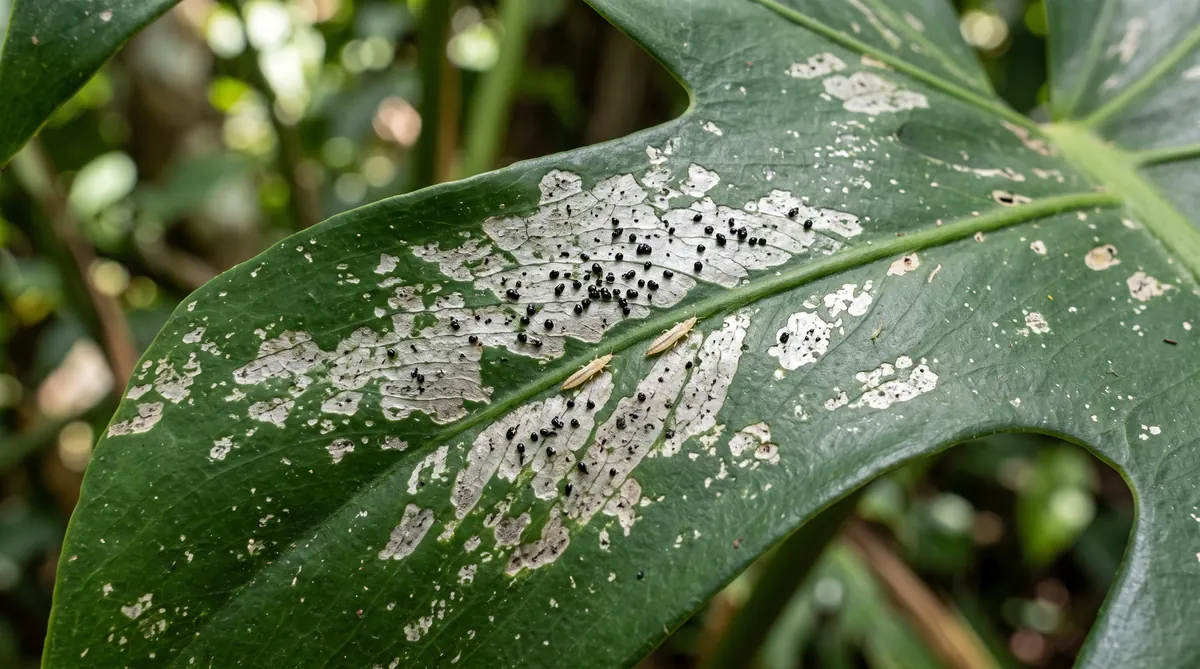
If you ask any veteran indoor collector to name their most dreaded pest, nine out of ten will say thrips without hesitation. I still remember the sinking feeling when I noticed dull, silvery patches forming on my prized giant Monstera. When I looked closer, I saw tiny black specks that looked like pepper dots. When I touched one with the tip of a pencil, it scurried away sideways with astonishing speed.
I sprayed the plant with neem oil, wiped down every leaf, and thought I had won. A week later, newly emerging leaves unfurled deformed, blackened, and full of holes. What I had not accounted for was the secret superpower of thrips: their ability to hide eggs inside living plant cells and pupate deep in the potting soil.
Thrips are formidable opponents, but they are not invincible. Once you understand their multi-stage life cycle and use compounds that penetrate plant tissue (translaminar activity), you can break their breeding cycle completely and protect your collection for good.
The Science: Endophytic Eggs and Multi-Stage Metamorphosis
1. Endophytic Oviposition (The Hidden Egg Armor)
Thrips belong to the insect order Thysanoptera (Lewis, 1997). Unlike spider mites or aphids that glue eggs onto the outer leaf surface, female thrips possess a serrated, saw-like organ called an ovipositor.
The female slices directly into the leaf epidermis and inserts her microscopic eggs inside the plant’s internal cellular tissue. Because the eggs sit beneath the plant’s cuticular skin, external contact sprays such as insecticidal soaps, alcohol mists, and horticultural oils cannot touch them. They remain 100% protected until they hatch.
2. The 5-Stage Life Cycle & Soil Pupation
Understanding where thrips live at each stage of their life is the key to defeating them (Morse & Hoddle, 2006):
- Stage 1: Egg (3 to 6 days): Safely buried inside the leaf tissue.
- Stage 2: Feeding Larvae / Nymphs (5 to 8 days): Cream-colored or pale yellow crawling nymphs that feed aggressively on foliar sap.
- Stage 3: Prepupa & Pupa (3 to 5 days): Mature larvae drop off the leaves and burrow into the top layer of potting soil or tight stem crevices, undergoing non-feeding transformation where foliar sprays cannot reach them.
- Stage 4: Winged Adults (20 to 30 days): Slender, dark brown or black torpedo-shaped insects with fringed wings capable of flying and leaping between nearby plants.
Broad-leaved favorites like Monstera Deliciosa and large White Bird of Paradise are prime targets because their expansive foliage offers endless surface area for egg laying and nymph feeding.
Diagnosis: Thrips vs Spider Mites vs Sunburn
Look for these unmistakable physical markers before deciding on your treatment course:
| Symptom | Thrips Infestation | Spider Mites | Sunburn / Light Bleaching |
|---|---|---|---|
| Foliar Damage | Silvery bleached patches with necrotic brown scars | Fine, uniform yellow/white stippling dots | Crisp, dry, tan or bleached patches on upper leaves |
| Fecal Residue (Frass) | Distinct shiny black tar-like droplets on leaves | Microscopic dirty webbing with white shed skins | Zero residue or specks |
| New Growth Impact | Unfurling leaves emerge twisted, stunted, or black | Slowed growth; leaves emerge normal but stipple quickly | New growth emerges healthy once plant is relocated |
| Pest Movement | Fast, jerky crawling; adults leap or fly when prodded | Slow, continuous crawling along silk threads | No living organisms present |
The 4-Stage Dual-Front Eradication Protocol
To eliminate thrips permanently, you must attack them on two fronts simultaneously: foliage and soil.
Stage 1: Foliar Translaminar Knockdown with Spinosad
The secret to killing thrips is using a compound with translaminar activity. Translaminar compounds soak through the leaf cuticle and sit inside the mesophyll cell layer (Kirst, 2010; Salgado, 1998).
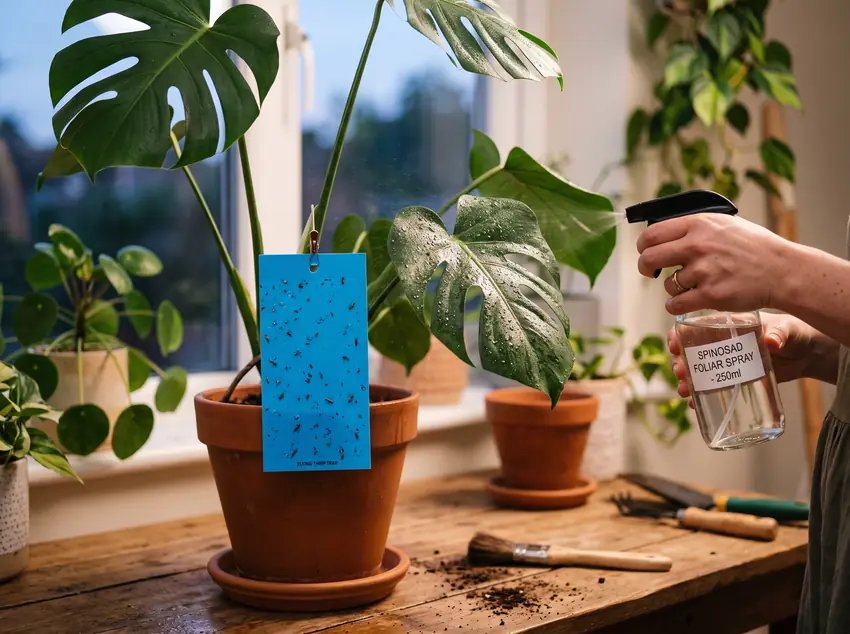
Spinosad (derived from the fermentation of the soil bacterium Saccharopolyspora spinosa) is the most effective organic compound against thrips. When newly hatched larvae bite into the leaf, they ingest spinosad, which over-activates their nicotinic acetylcholine receptors, causing rapid paralysis and death within 24 to 48 hours.
Application Rule: Spray spinosad thoroughly on all top and bottom leaf surfaces in the evening. Repeat this spray once every 5 to 7 days for 3 consecutive weeks. This catches each new batch of larvae as they hatch from the leaf interior.
Stage 2: Soil Pupation Disruption (Substrate Defense)
While foliar sprays target larvae, you must stop the pupae hiding in the potting mix. Choose one of two methods:
- Option A (Systemic Granules): Apply systemic granules (imidacloprid or acetamiprid) to the potting soil. As the roots absorb the compound, any feeding pupa or emerging crawler that contacts the plant dies.
- Option B (Biological Soil Drench): Water the soil with beneficial entomopathogenic nematodes (Steinernema feltiae). These microscopic nematodes actively hunt down and consume thrips pupae in the potting mix.
Stage 3: Blue Sticky Card Interception
While fungus gnats are drawn to yellow cards, multiple entomological studies demonstrate that thrips are strongly attracted to bright blue sticky cards. Hang blue sticky cards directly at canopy height to capture flying adults before they can mate and deposit new eggs.
Stage 4: Debridement of Damaged Foliage
If an older leaf is heavily covered in silver scarring and black frass, it contains hundreds of embedded eggs. Prune off that single compromised leaf and dispose of it in a sealed outdoor trash bag. This instantly removes a huge portion of the pest population.
Troubleshooting Thrips Control
• Why Did Neem Oil Fail to Stop My Thrips?
Neem oil is a gentle contact repellent. Because thrips eggs are embedded inside the leaf and pupae live in the soil, neem oil only touches the small percentage of nymphs active on the leaf surface at that exact moment. It cannot penetrate tissue like spinosad does.
• Are Spinosad Sprays Safe to Use Indoors?
Yes, spinosad has very low mammalian toxicity and is OMRI-listed for organic gardening. However, it is toxic to bees when wet, so keep treated plants indoors away from pollinating insects until the foliar spray has dried completely.
• Will Damaged Leaves Recover Their Green Color?
Scarred, silvery leaf tissue cannot regenerate lost chlorophyll. However, once you eliminate the infestation, all future emerging leaves will grow vibrant, glossy, and completely undamaged.