Spider Mites on Tropical Foliage: How to Eliminate Them
How microscopic arachnids suck chloroplasts dry, why dry winter air accelerates their breeding cycle, and the complete field-tested protocol to eliminate them.

The Ghostly Webs That Appear Overnight
Early in my plant-keeping journey, I noticed my favorite Alocasia looked slightly dull, like someone had dusted the broad leaves with fine talcum powder. I wiped the leaves with a wet cloth and thought nothing of it. Four days later, fine silken webbing spanned every leaf tip, and the deep green foliage had bleached into a washed-out, lifeless yellow.
Under a 30x jeweler’s loupe, that harmless “dust” resolved into hundreds of eight-legged microscopic arachnids scurrying along the leaf veins. That was my painful introduction to Tetranychus urticae, the two-spotted spider mite.
Spider mites are notoriously persistent indoor pests because they reproduce exponentially in warm, dry household air. If you spray them once with an off-the-shelf bug spray and call it a day, their eggs hatch three days later and the infestation rebounds twice as strong. Beating spider mites requires understanding their population biology, using physical knockdowns, and applying proper contact acaricides on a timed schedule.
The Science: Spider Mite Biology and Feeding Mechanics
1. How Mites Destroy Plant Tissue (Stylet Piercing)
Spider mites are not true insects; they are tiny arachnids closely related to ticks and spiders (Helle & Sabelis, 1985). They possess sharp, needle-like mouthparts called cheliceral stylets.
The mite punctures the individual epidermal cells on the underside of plant leaves and extracts the interior cellular contents, specifically targeting chloroplasts and nutrient-rich sap. Each puncture kills an individual plant cell, creating a tiny white or pale yellow dot on the leaf surface known as chlorophyll stippling. As thousands of punctures accumulate, the leaf loses its photosynthetic capacity and eventually drops off.
2. The Temperature & Humidity Multiplication Curve
The most dangerous characteristic of spider mites is their reproductive speed under indoor conditions. Classic acarology studies (Boudreaux, 1958; Hazan et al., 1973) revealed that spider mite egg development is directly governed by ambient temperature and relative humidity:
- In Cool, Humid Conditions (65°F / 18°C and 75% RH): Egg-to-adult lifecycle takes 20 to 24 days. Female fecundity is low, and mite mortality is high.
- In Warm, Dry Indoor Air (80°F / 27°C and 30% RH): The entire egg-to-adult lifecycle accelerates to just 4 to 5 days! A single mated female can lay up to 20 eggs per day, producing millions of descendants in a single month.
This is why tropical species with thin foliage like Calathea Orbifolia and Alocasias suddenly explode with spider mites every winter when home heating dries out the air. We detailed how vapor pressure deficit affects transpiration and leaf surface microclimates in Mastering Indoor Humidity: VPD and Plant Physics.
Diagnosis: Spider Mites vs Thrips vs Fungal Rust vs Dust
Early identification is essential before silk webbing covers the foliage. Use this diagnostic matrix to verify what is attacking your leaves:
| Diagnostic Feature | Spider Mites (*Tetranychus*) | Thrips Infestation | Household Dust |
|---|---|---|---|
| Damage Pattern | Fine, pinprick yellow/white stippling across leaf blade | Silvery, bleached patches with black tar-like frass dots | Uniform gray haze on top leaf surface only |
| Presence of Webbing | Fine silk webs spanning leaf tips, petioles, and veins | No silk webbing produced at any stage | None (occasional harmless single cobwebs) |
| White Paper Test | Shake leaf over paper: tiny red/brown specks crawl slowly | Elongated, torpedo-shaped insects crawl rapidly | Stationary particles that do not move |
| Target Location | Primary feeding concentrated on leaf undersides | Both leaf sides, inside unfurling new growth tips | Top surface exposed to ambient airflow |
The 4-Stage Spider Mite Eradication Protocol
Because spider mite eggs are impervious to many gentle contact sprays, single treatments always fail. Follow this four-stage routine to achieve 100% eradication:
Stage 1: The Mechanical Shower Knockdown
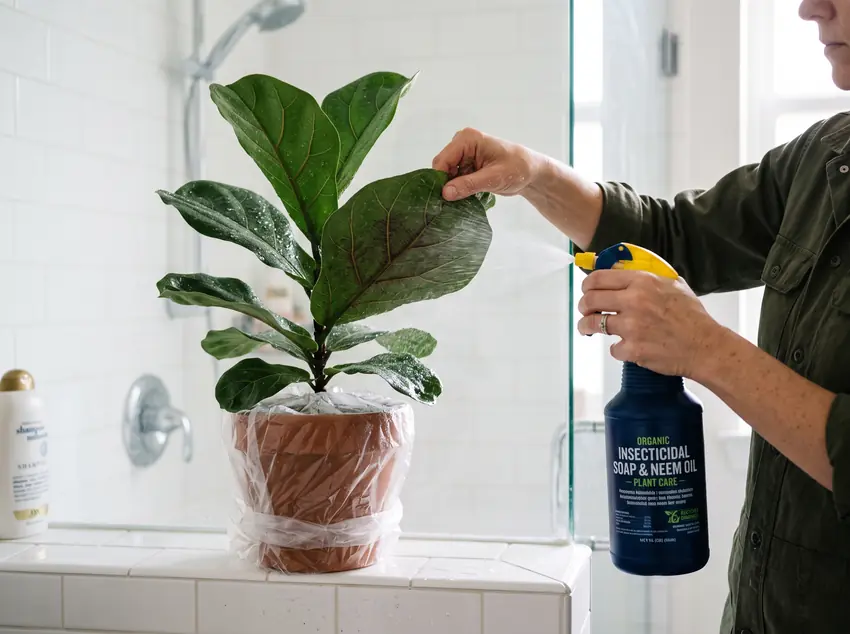
Carry the infected plant to the shower or garden hose. Cover the potting soil with a plastic grocery bag so you do not waterlog the root ball. Using lukewarm water and moderate pressure, spray the entire plant thoroughly, paying special attention to the undersides of every leaf and the junctions where petioles meet the stem.
Physical water pressure instantly destroys the protective silk webbing and washes away 80% to 90% of active nymphs and adult mites, dramatically reducing pest pressure before applying any chemical treatments.
Stage 2: Saponification and Fatty Acid Suffocation
Once the foliage dries slightly, apply a contact suffocation spray. Insecticidal soaps containing potassium salts of fatty acids disrupt the protective lipid layer of the mite cuticle, causing rapid dehydration and membrane collapse (Cranshaw, 2004).
The Homemade Emulsion Formula:
- 1 Quart (1 Liter) lukewarm distilled or filtered water
- 1 Teaspoon pure liquid Castile soap (unscented or peppermint)
- 1 Teaspoon cold-pressed, clarified hydrophobic neem oil or horticultural mineral oil (acts as a suffocating film and ovicide)
- Shake vigorously before every spray to maintain emulsion.
Stage 3: The 3-Day Repeat Cycle (Breaking the Egg Loop)
This is where 90% of plant parents fail. No gentle organic spray kills all spider mite eggs. The eggs will hatch 3 to 4 days after your first spray. Therefore, you must spray the plant thoroughly every 3 to 4 days for a total of 4 cycles (14 days total).
This ensures you kill every newly hatched generation before they reach reproductive maturity and lay fresh eggs.
Stage 4: Advanced Chemical Weapons (Sulfur & Spinosad)
For stubborn or widespread outbreaks on large collections, micronized wettable sulfur is the gold standard agricultural acaricide. Sulfur interferes with mitochondrial respiration in mites.
Mix 1 tablespoon of wettable sulfur per gallon of water and spray thoroughly. Safety Note: Never apply sulfur within 30 days of using horticultural oils, as sulfur-oil combinations cause severe phytotoxic chemical burns on foliage.
Long-Term Prevention: Microclimate Defense
Eradicating an outbreak is only half the battle; preventing re-infestation keeps your collection safe year-round:
- Maintain 55%+ Ambient Humidity: High humidity slows down mite feeding and drastically extends their egg incubation timeline.
- Routine Foliar Rinsing: Make monthly shower rinses part of your normal watering schedule to wash away pioneer mites before colonies establish.
- Microfiber Leaf Wiping: Gently wipe smooth foliage with a damp cloth every two weeks to remove dust and resting females.
Troubleshooting Spider Mite Treatments
• Leaves Burned or Dropped After Spraying Neem Oil
Oils magnify light and clog stomata under hot, bright conditions. Always spray treatments in the evening or move plants away from direct sunlight and grow lights until the foliage is dry.
• Can I Use Beneficial Predatory Mites Indoors?
Yes! Predatory mites like Phytoseiulus persimilis and Neoseiulus californicus are phenomenal biological controls. However, you must stop all chemical and soap sprays at least 7 days before introducing predators, or you will accidentally kill them.
• The Leaves Are Stippled: Will the Green Color Return?
Unfortunately, once leaf cells are emptied by stylet punctures, that specific tissue cannot heal. Focus on protecting emerging growth; new leaves will emerge pristine, green, and vibrant once the mites are gone.